The Pareto Principle: A Simple Way to Improve Manufacturing Productivity
Discover how the Pareto Principle help prioritise efforts and boost productivity in manufacturing, from production losses to quality issues.
Updated 12 March 2025 5 min read
In the manufacturing industry operations, challenges and issues sprout at every turn. From production losses to quality control, sustainability and energy concerns, it’s easy to feel overwhelmed by the many problems that demand attention. However, there’s a simple but strategic tool that can help us cut through the chaos and prioritise our efforts effectively, increasing productivity —the Pareto Principle.
Understanding the Pareto Principle
The principle is named after Vilfredo Pareto, an Italian economist. In 1906, Pareto noted that 20 per cent of the population in Italy owned 80 per cent of the property. He proposed that this ratio could be found in many places in the physical world and theorised it might indicate a natural law. Also known as the 80/20 rule, the Pareto Principle suggests that roughly 80% of effects come from 20% of causes.
In the context of the manufacturing industry, this principle holds immense value, meaning that 80% of the results can be achieved by focusing 20% of the effort on the most important things. A small fraction of our problems likely contribute to most of our challenges. Identifying and addressing these critical issues can unlock significant operational efficiency and performance improvements.
 *Image 1: The Pareto Principle Illustrated. *
Everyday Challenges in Manufacturing
The daily routine in the industrial sector can be overwhelming, from raw material shortages to equipment malfunctions. It’s easy to get bogged down by the volume of problems, leading to a sense of helplessness.
When you examine your “To Do” list, only a few tasks matter significantly. The 80/20 rule suggests focusing on crucial items with the most substantial outcomes rather than completing numerous smaller tasks for satisfaction. Although your list may not shrink substantially, you’ll be honing your skill of effective prioritisation.
This is where the Pareto Principle comes into play. Instead of attempting to tackle every issue simultaneously, the principle encourages us to focus on the vital few—those critical problems that have an outsized impact on our operations.
Implementing the Pareto Principle for Improved Operational Efficiency
The manufacturing industry can achieve operational efficiency by strategically and consistently implementing the Pareto Principle, which provides a solid theoretical foundation for this purpose. To guide this process, follow these four key steps:
-
Problem Identification: Begin by assessing the various challenges your operation faces. Categorise them based on their impact and frequency. For example, within the process manufacturing industry, potential categories are production losses, energy and raw material consumption, quality issues, safety incidents, emissions, and variable manufacturing costs.
-
Data Analysis: Utilise data and analytics to identify patterns. Adopt a digital platform like Cyzag to do this effortlessly. Cyzag gets insights and uncovers which issues consistently contribute to most setbacks.
-
Planning and Execution: Armed with insights from data analysis, develop a focused action plan that addresses the vital few issues. Manage tasks and allocate resources strategically to maximise operational efficiency.
-
Continuous Improvement: Regularly reassess and refine your approach. As the industry evolves, so will the critical factors influencing your operations.
Pareto Principle Example for Improving Production Losses
Imagine a scenario where production losses lead to delayed deliveries at a chemical manufacturing site. Instead of spreading resources thinly, the Pareto Principle suggests focusing on the critical 20% responsible for 80% of setbacks. This can enhance operational efficiency, addressing specific issues like raw material inconsistencies or recurring equipment failures.
Data Analysis and Production Losses
Upon analysing the data, it became evident that the chemical plant had incurred a substantial production loss of 791 tons over the last three months. This allows us to allocate attention and resources more strategically, addressing the root causes efficiently.
We built a Pareto chart to represent these insights visually, and it highlights key problem areas, as depicted in image 2 below. This visual tool serves as a roadmap for targeted improvements and streamlined resource allocation in the chemical manufacturing process.
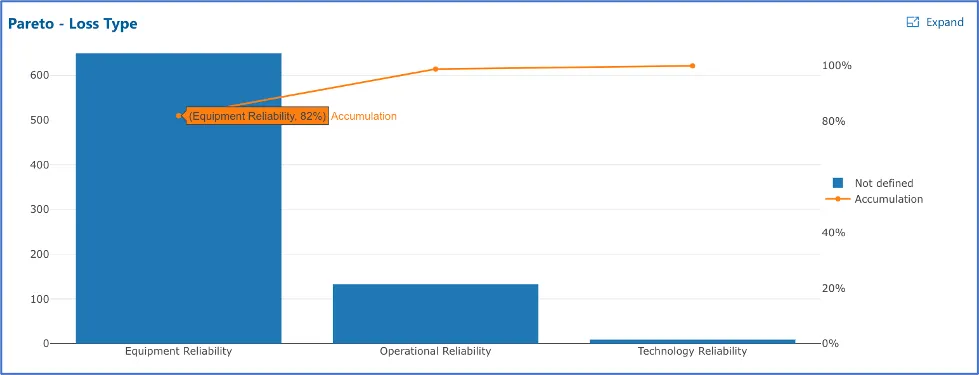 *Image 2: Pareto loss chart *
Upon completing the chart, it became apparent that equipment reliability accounted for most of the production losses, constituting approximately 82%. Consequently, prioritising operational reliability (17%) or technological issues (1%) was deemed less impactful.
With equipment reliability identified as the primary focus, a deeper examination was essential to understand the specific pieces of equipment contributing to this loss. Thus, a second Pareto chart was developed, introducing a new category based on functional location, as depicted in Image 3.
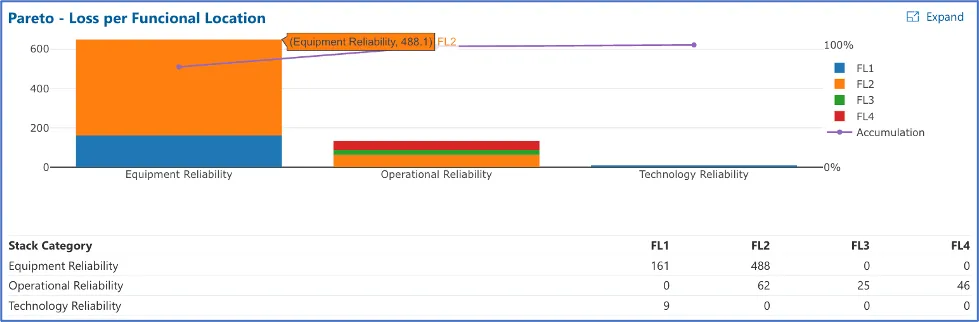 *Image 3: Pareto loss chart per functional location *
Analysis of this chart revealed that FL2 (Functional Location 2), housing the reactor feed pump, contributed the most significant share to equipment reliability losses, amounting to approximately 75%. Delving into the specifics of FL2, a root cause analysis, such as 5 Whys, will be conducted to resolve the issues associated with the reactor feed pump.
Addressing the concerns related to FL2 will effectively mitigate 75% of the overall loss. Following the resolution of these issues, attention will shift to FL1 (crystalliser agitator), addressing the remaining 25%.
Once equipment reliability concerns are rectified, the focus will shift to operational reliability losses. The initial step in this phase would be addressing issues within FL2, potentially resolving root causes identified in the previous equipment reliability analysis. Subsequently, attention will turn to FL4 (mixing pH meter).
Making Pareto Easy with Digital
Leveraging digital tools can amplify the effectiveness of the Pareto Principle. Digital platforms like Cyzag provide a seamless solution for managing data, building Pareto charts, and registering and tracking actions for root-cause problem-solving analysis.
By digitising these processes, manufacturing professionals can streamline workflows, enhance collaboration, and gain real-time insights into operational challenges. The key benefits are:
-
Data Management: Easily organise and centralise your data, making it accessible for analysis.
-
Pareto Chart Creation: Generate Pareto charts effortlessly to identify and prioritise critical issues for improved operational efficiency visually.
-
Action Registration: Record and manage actions derived from Pareto analysis, ensuring a systematic approach to problem-solving for enhanced operational efficiency.
-
Root Cause Analysis: Facilitate in-depth root cause analysis, helping to address the core issues behind operational challenges.
-
Collaboration and Communication: Enhance teamwork by providing a centralised platform for communication and collaboration on problem-solving initiatives in the manufacturing industry.
Summary
The Pareto Principle offers a powerful strategy for prioritisation in a field where numerous challenges are constant companions. Moreover, focusing on the crucial 20% of issues responsible for 80% of disruptions and leveraging digital platforms such as Cyzag opens opportunities to improve operational efficiency.
Seamlessly integrate the Pareto Principle with Cyzag’s capabilities in the process industry. Optimise efficiency using a digital platform for streamlined problem-solving and collaboration.
Follow Cyzag on LinkedIn for new articles and stories.