Why Documentation Alone No Longer Satisfies ISGOTT 6 in Liquid Terminals
ISGOTT 6 compliance in liquid terminals now requires more than documentation. Here is what genuinely closes the gap.
10 min read
Most liquid terminals working to meet ISGOTT 6 compliance evidence have already completed rounds, handovers, and Ship/Shore Safety Checklists. The growing challenge is demonstrating continuous operational awareness across shifts, people, and time under increasing scrutiny from SIRE 2.0. As human factors continue driving a significant share of negative observations, terminals that still depend heavily on memory, fragmented logs, and individual experience are becoming more vulnerable during audits, vetting inspections, and vessel operations. This article explores how connected operator rounds, structured handovers, and AI-supported pre-arrival exchanges help close that gap before it becomes visible during the moments that matter most.
When the Inspection Starts Before the Vessel Arrives
During many vetting inspections today, the difficult part is no longer proving that procedures exist. Most terminals already have the required documentation, checklists, and routines in place. The greater challenge is demonstrating that operational awareness remained visible and consistent across shifts, operational decisions, and vessel activities without reconstructing the story afterwards.
That shift matters because SIRE 2.0 has changed how the industry evaluates operational evidence. Increasingly, inspectors focus not only on whether activities occurred, but also on whether the operation can demonstrate what was observed, what changed, what decisions were made and whether that understanding persists over time and across people.
Analysis published from the 2025 INTERTANKO SIRE 2.0 Benchmarking data shows that human factors account for 37% of all negative observations across the programme. In many cases, the issue is not missing procedures or documentation. It is operational knowledge that does not consistently carry forward between people, shifts, and operational stages.
This article explores what closes that gap through three connected operational steps:
-
The operator round that builds the operational picture;
-
The shift handover that transfers and preserves it;
-
The pre-arrival exchange that puts it into use before the vessel reaches the berth.
Because by the time a vessel is approaching the terminal, operational continuity either already exists or it does not.
The Gap Between Documentation and Operational Awareness
Experienced terminal managers recognise the situation immediately. A vessel is approaching, an inspector asks to see the operational picture from the last two weeks, and suddenly the operation needs to demonstrate not only that procedures were completed, but that operational understanding remained visible throughout the process.
In some terminals, the answer is immediately available. The operational history is structured, searchable, and traceable across shifts. In others, the next hours involve searching through logs, calling supervisors, checking spreadsheets, and reconstructing the sequence from memory.
Both terminals may technically comply with ISGOTT 6. But building genuine ISGOTT 6 compliance evidence in liquid terminals requires more than completed checklists. The difference is whether operational awareness survives across time
That challenge is becoming harder as experienced operators retire, contractor rotation increases, staffing becomes leaner, and operational pressure grows. At the same time, audits and vetting programmes increasingly expect evidence that operational understanding is continuously embedded in the workflow rather than rebuilt afterwards.
Step 1 — The Operator Round Builds the Operational Picture
The operator round is where the operational picture begins. Every shift, operators inspect assets, verify conditions, and record findings. The critical question is whether those findings continue to exist operationally after the round is complete.
In many terminals, observations remain isolated inside the round record: a note in a logbook, a checklist completion, or awareness carried temporarily by the people currently on shift. The problem becomes visible later, when the next operational stage depends on information that was never properly preserved.
If the operational picture built during the round does not remain visible afterwards, the shift handover depends heavily on memory, and the pre-arrival exchange depends on reconstruction. The operation gradually becomes more dependent on who happens to be present during critical moments.
In a connected operational workflow, findings become linked to relevant assets, previous observations, and operational history across shifts. Over time, patterns begin to emerge. A loading arm repeatedly shows small deviations. A berth behaves differently during colder mornings. A transfer condition drifts after handling a specific product.
Individually, these observations may not appear critical. Together, they create operational context.
That context matters directly under ISGOTT 6 because the Ship/Shore Safety Checklist depends on the terminal already having a current operational picture before the vessel arrives.
How AI Supports the Operator Round
This is where AI becomes operationally useful in a practical way. An operator can observe what is directly in front of them, but recognising whether the same condition appeared elsewhere in the terminal, across previous shifts, or during earlier transfers is far more difficult.
AI continuously compares new observations against accumulated operational history and surfaces patterns that would be difficult to detect manually. The operator still records the finding and experienced personnel still make the operational decisions. What changes is the operation’s ability to preserve and retrieve operational knowledge across time.
The round stops being an isolated activity and starts becoming a continuously building operational picture.
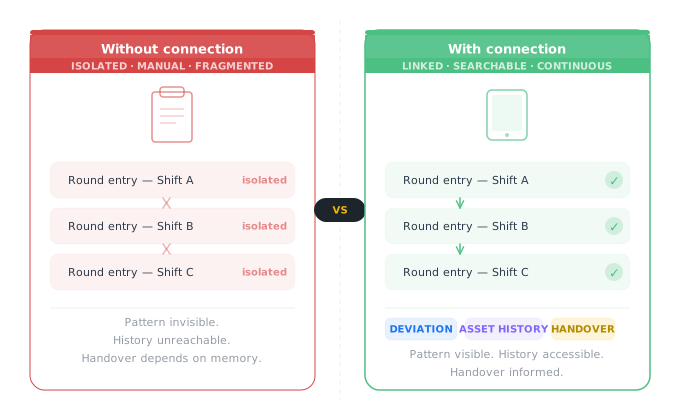 Image 1: Unconnected x Connected Rounds in Liquid Terminals.
Step 2 — The Shift Handover Preserves and Transfers That Picture
If the operator round builds the operational picture, the shift handover determines whether that picture survives into the next shift.
Most terminals already invest significant effort into handovers, but even well-executed handovers become vulnerable when observations remain disconnected across spreadsheets, notes, separate systems, and verbal conversations. Supervisors then spend much of the handover reconstructing the current operational picture rather than reviewing one that already exists.
A connected handover changes the supervisor’s role entirely. Instead of rebuilding the operational picture from memory, the outgoing supervisor reviews and validates a structured operational history already assembled from rounds, active deviations, unresolved conditions, and asset history.
The incoming shift starts with context, not only instructions.
That distinction matters because instructions tell the next shift what to do, while operational context explains why the situation matters, what changed, and what requires attention next.
How AI Supports the Handover
Rather than supervisors manually assembling handover reports from multiple sources, the platform automatically organises relevant operational information into a structured briefing. The supervisor still reviews, edits, validates, and signs off the handover, but the reconstruction work is dramatically reduced.
Instead of searching through logs or manually compiling updates from separate systems, the supervisor can focus on reviewing the operational picture itself. The result is more reliable transfer of operational awareness between shifts.
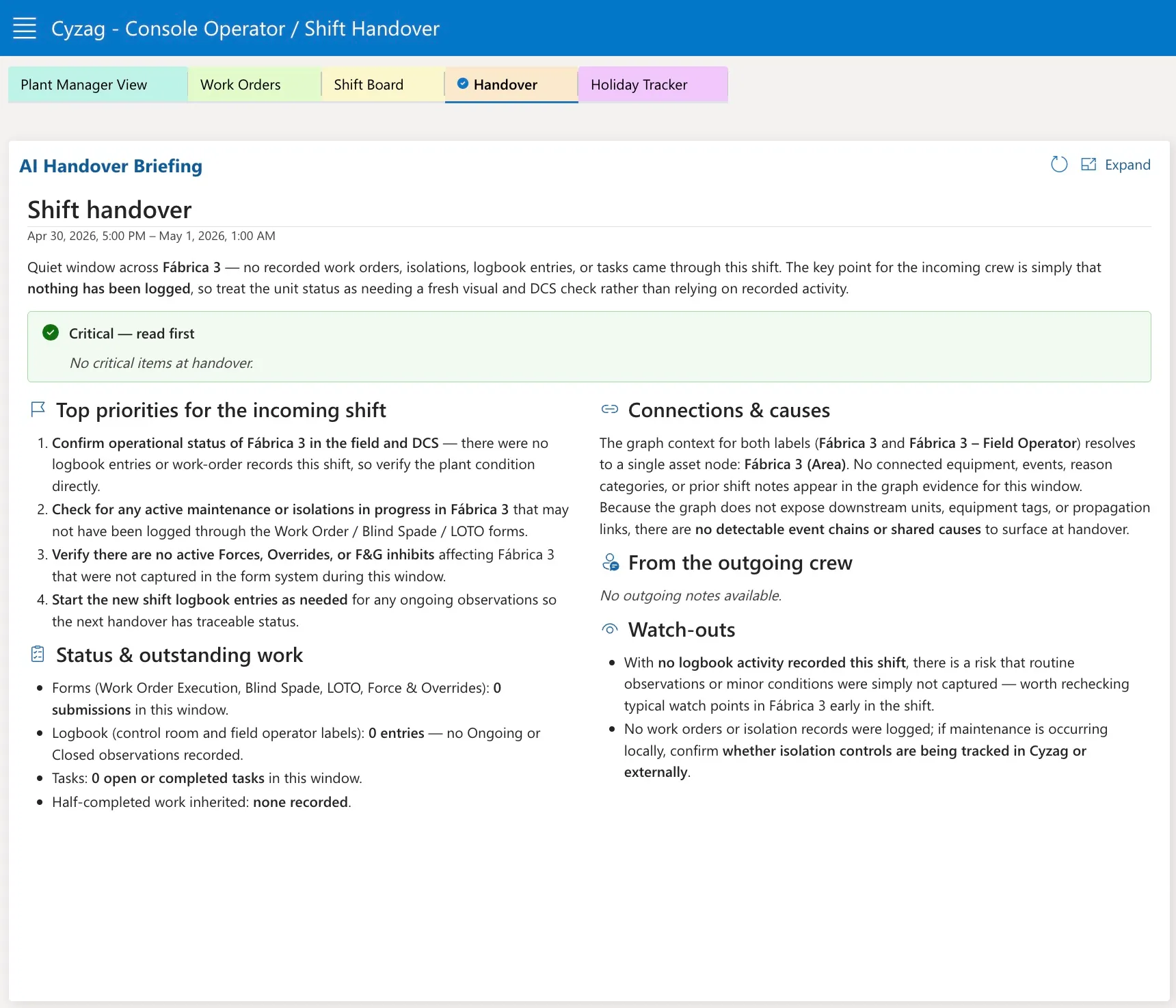 *Image 2: Cyzag AI Handover Briefing *
Step 3 — The Pre-Arrival Exchange Puts the Operational Picture Into Use
The pre-arrival exchange is where the operational picture must prove itself. Before cargo transfer begins, the terminal and vessel need a shared understanding of berth condition, operational constraints, active deviations, equipment status, and transfer considerations.
ISGOTT 6 places clear importance on this exchange occurring before the vessel moors. By that stage, the terminal’s operational awareness should already be current, accessible, and reliable.
This is where disconnected workflows become visible very quickly. If the operational picture was not preserved during the round and handover stages, the terminal representative now needs to reconstruct the critical operational context while the vessel is already approaching. The operation becomes dependent on memory, separate logs, verbal explanations, and the availability of experienced personnel.
When the first two steps are properly connected, the pre-arrival exchange becomes much simpler because the operational picture already exists continuously within the workflow. The terminal representative already has access to recent berth observations, unresolved conditions, active deviations, and relevant operational history prior to the vessel’s arrival.
From the terminal perspective, this directly affects the quality of the Ship/Shore Safety Checklist itself. The checklist becomes more than a confirmation exercise because both ship and shore are working from an operational picture that was already preserved across previous shifts, rather than assembled minutes before cargo operations begin. The discussion becomes more credible, the operational alignment becomes clearer, and the terminal is in a far stronger position to demonstrate genuine operational awareness during vetting inspections and audits.
How AI Makes the Operational Picture Instantly Accessible
Before vessel arrival, the terminal representative can ask natural language questions such as “What was observed on berth 3 during the last ten days?” or “Are there any active deviations related to the loading arm?” The answers come directly from connected operational history rather than memory or manual searches through logs.
The terminal representative still conducts the exchange, and experienced personnel still make the operational decisions. What changes is the speed and reliability of access to the operational context.
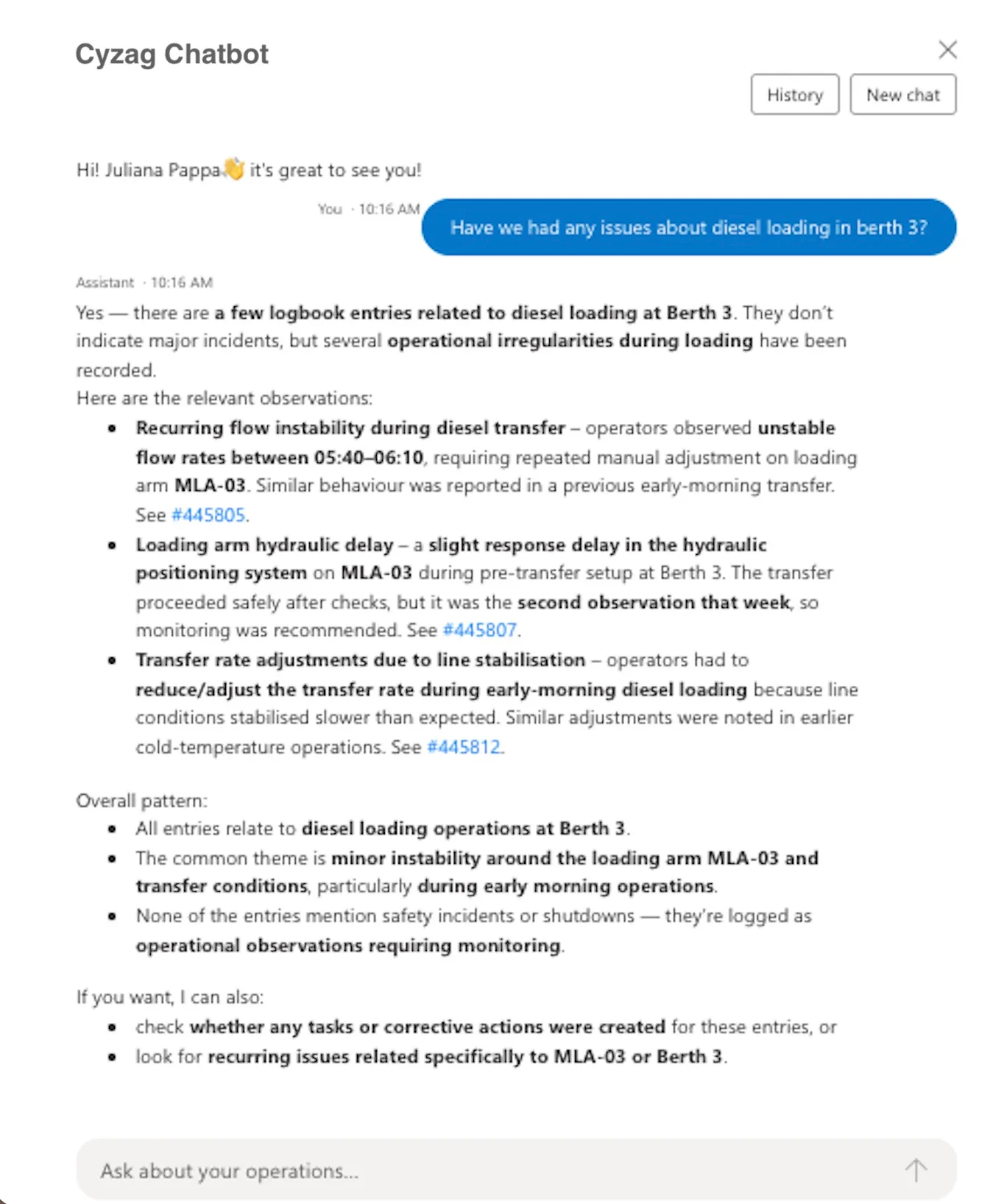 Image 3: Cyzag AI Chatbot Uncovering berth observations and linked operational history.
What This Looks Like in Practice
Consider a terminal preparing for a vessel arrival involving a more complex berth configuration while the senior operator normally responsible for that berth is on leave.
In many terminals, this immediately creates operational vulnerability because the incoming team now depends heavily on verbal explanations, individual recollection, and searching through previous records to understand what happened during similar operations.
In a connected operational workflow, the operator covering the berth can immediately review recent operational history, including previous deviations, recurring operational behaviour, unresolved observations, and actions taken during similar transfers.
The pre-arrival exchange happens on time and with confidence. When the Ship/Shore Safety Checklist is completed, both the terminal and vessel are working from a current operational picture supported by traceable operational history rather than reconstructed memory. Questions about berth conditions, deviations, or operational constraints can be answered immediately using information already preserved across previous shifts.
If the interaction is later reviewed during a vetting inspection, the inspector is not evaluating whether the terminal managed to rebuild the story afterwards. They are evaluating whether operational awareness remained continuously visible throughout operations.
That distinction is increasingly becoming one of the most important operational differences in liquid terminals today. ISGOTT 6 has always depended on effective communication, operational awareness, and shared understanding at the ship/shore interface. What SIRE 2.0 has changed is the level of visibility and scrutiny around how consistently that operational awareness is demonstrated across shifts, teams, and time.
The Practical Starting Point
Most terminals do not need to redesign operations completely to improve continuity. The rounds, handovers and pre-arrival exchanges already happen.
The real question is whether the operational knowledge created during those activities survives long enough to support the next operational stage.
A useful starting question is simple: if an inspector arrived right now and asked to see the operational picture from the last two weeks, would the terminal be showing a continuous operational history, or a reconstruction assembled afterwards?
Ready to Strengthen Operational Continuity at Your Terminal?
If your terminal is preparing for a vetting inspection, improving ship/shore operational readiness, or reducing dependence on fragmented logs and operational memory, Cyzag helps liquid terminals preserve operational awareness across rounds, handovers, and vessel operations.
By connecting operational workflows into one continuous operational picture, terminals can strengthen pre-arrival exchanges, improve operational continuity, and approach audits and inspections with greater confidence. Reach us at cyzag.com.
FAQ — ISGOTT 6, AI, and Operational Continuity
The following questions address common concerns about ISGOTT 6, AI, and operational continuity in liquid terminals.
Our terminal already completes rounds and handovers. What changes when they become connected?
The activities stay largely the same. What changes is that the operational context remains visible across rounds, handovers, and vessel preparation, rather than relying on memory or disconnected records.
How does AI support operations without creating additional safety risks?
The AI acts as an operational support layer, not an autonomous decision maker. It organises information, surfaces patterns, and provides faster access to operational history while operators and supervisors remain fully responsible for operational decisions.
How does this relate to SIRE 2.0 specifically?
SIRE 2.0 increasingly evaluates operational behaviour and human factors around the ship/shore interface. A continuous operational history strengthens the terminal’s ability to demonstrate reliable operational continuity during inspections and reviews.
Can rounds still be completed digitally in areas with limited connectivity?
Yes. Operators can complete rounds offline using tablets or mobile devices. The platform synchronises automatically once connectivity returns.
Is this only relevant for Seveso III terminals?
No. The operational continuity challenge exists across liquid terminals operating under ISGOTT 6 regardless of geography or local regulatory framework.
Follow Cyzag on LinkedIn for new articles and stories.