ISGOTT 6 for Liquid Terminals: What the Standard Actually Requires
ISGOTT 6 and SIRE 2.0 for liquid terminals: what they require, why the ship/shore interface matters, and where most terminals have a gap.
10 min read
If you manage safety or operations at a liquid terminal, you have certainly heard of ISGOTT 6 and SIRE 2.0. You may also have a nagging sense that your terminal is not fully aligned with what they require, even though the paperwork looks right. This article explains both frameworks from the ground up: what they are, what they actually require of terminals day to day, and how they connect. The gap between compliance on paper and in practice is one important operational problem terminals have not yet named.
What ISGOTT 6 Is (and What It Is Not)
ISGOTT stands for International Safety Guide for Oil Tankers and Terminals. It is the industry’s primary reference document for the safe operation of tankers and the terminals they visit. First published in 1978 and updated several times since, OCIMF and ICS, together with the International Association of Ports and Harbours, released the sixth edition in 2020.
The first thing to understand about ISGOTT 6 is what kind of document it is. It is not a law. No government enacted it. No regulator can issue a fine for non-compliance with it directly. It is a guide: a comprehensive, industry-agreed set of best practices and recommendations covering everything from cargo transfer procedures to enclosed space entry, fire protection, human factors, and the ship/shore interface.
What gives it practical force is commercial pressure. Oil companies, charterers, and cargo owners use ISGOTT 6 as the benchmark when they decide which terminals to work with. If your terminal does not follow it, vessels chartered by major oil companies may simply not come to you. That is not a regulatory consequence; it is a commercial one. In the liquid terminal industry, the distinction barely matters.
ISGOTT 6 is not a regulation. But not following it is not really an option either.
What ISGOTT 6 Changed for Liquid Terminals
Previous editions of ISGOTT focused primarily on technical requirements: equipment, procedures, physical safety. The sixth edition introduced two significant changes that directly affect how terminals operate day to day.
Human factors became a formal focus
For the first time, ISGOTT 6 explicitly addressed human factors: how people communicate, transfer knowledge, make decisions under pressure, and carry operational awareness across shifts. The guide’s authors consulted specialists from the airline industry to understand what makes safety systems genuinely effective rather than merely documented.
The practical implication is significant. ISGOTT 6 for liquid terminals does not require terminals to have procedures alone. It emphasises the need for procedures to be effectively understood and applied in practice. That means the people operating the terminal actually know what is happening across their assets. Not just that a form has been signed.
The pre-arrival exchange became a stronger expectation
Under ISGOTT 5, the Ship/Shore Safety Checklist was primarily completed after a vessel moored. ISGOTT 6 places a stronger emphasis on early and effective information exchange between the terminal and the arriving vessel, including before arrival.
This creates a clear expectation on the terminal. The terminal must have a current, accurate operational picture ready before the ship moors: tank conditions, active deviations, known constraints, anything that affects the safe conduct of the transfer. That information needs to be structured and accessible, not held in the memory of whoever happens to be on shift.
In practice, this means the operator round completed during the previous shift, and the handover that followed it directly feeds into a terminal’s ability to satisfy ISGOTT 6’s pre-arrival requirements. A terminal where rounds are logged in paper notebooks, and handovers happen verbally, will typically struggle to produce that picture reliably and consistently.
What Is SIRE 2.0 and Why Liquid Terminals Are Affected
SIRE stands for Ship Inspection Report Programme. It is OCIMF’s inspection system for tankers; not for terminals. An inspector boards the vessel, assesses it, and publishes the result in a shared database. Oil companies and charterers use that database when deciding whether to charter a ship.
OCIMF’s updated digital programme, SIRE 2.0, replaced VIQ7 on 2 September 2024. It is now the sole vetting standard for tankers using the OCIMF programme.
The critical change in SIRE 2.0 is that every inspection is now placing explicit and structured emphasis on hardware conditions, procedural compliance, and human factors. The human factors dimension was present in ISGOTT 6 as a principle. SIRE 2.0 turned it into a more systematically assessed and documented inspection finding.
Why this matters for terminals even though it inspects ships
SIRE 2.0 does not inspect terminals directly. But it assesses the ship/shore interface. That includes how the terminal conducted itself during the pre-arrival exchange, the transfer conference, and the cargo operation.
If the terminal’s operational picture was not current, or the pre-arrival communication did not happen properly, that can generate a negative observation on the vessel’s SIRE 2.0 report.
That report stays active in the OCIMF database for 12 months, visible to every oil company, charterer, and cargo owner evaluating whether to use a vessel. If your terminal consistently creates friction at the ship/shore interface, that friction shows up in those reports. The terminal does not receive a SIRE 2.0 score directly. But it can cause the ships that visit it to receive poor ones. And in a market where vetting results determine commercial access, the consequence is the same.
Industry analyses of early SIRE 2.0 data indicate that a significant share of observations are now linked to human factors, particularly within safety management and operational practices. A year into the new standard, the industry’s primary compliance gap is not equipment or paperwork. It is operational knowledge and how it moves, or fails to move, through organisations.
The ISGOTT 6 Gap Most Liquid Terminals Already Know About
Put ISGOTT 6 and SIRE 2.0 together, and the picture becomes clear. Both frameworks are asking the same question: Does your terminal genuinely know what is happening across its assets, shift after shift? Or does it rely on experienced operators carrying that picture in their heads?
Most terminals have expanded their compliance activity in response to regulatory pressure. Rounds are logged more formally. Checklists are longer. Sign-off procedures have multiplied. The documentation is more thorough than it was five years ago.
And yet the same conditions keep recurring. The same deviations appear on different shifts without connecting to a pattern. The same knowledge gaps surface when a senior person is absent or when a team changes. The shift handover happens, but what it transfers is a summary rather than a connected record. This is the operational continuity problem that ISGOTT 6 implicitly seeks to address through its focus on communication, awareness, and the ship/shore interface, and that SIRE 2.0 is now more explicitly measuring.
This is the compliance trap. A terminal can satisfy the documentation requirements of ISGOTT 6 and still contribute to poor SIRE 2.0 outcomes. Documentation and operational awareness are not the same thing.
Compliance on paper and compliance in practice are not the same thing. The gap between them is where most incidents begin.
What the Connection Between Rounds, Handovers and Compliance Actually Looks Like
ISGOTT 6’s requirements for liquid terminals come down to one capability: producing a current, accurate, structured operational picture at any moment. Before a vessel arrives. During a transfer. After an incident. During an audit.
Three points in the terminal’s daily operation build or break that capability. The Ship/Shore Safety Checklist tests it, but does not build it. The round captures the operational picture, the handover preserves it, and the pre-arrival exchange puts it to use. By the time the checklist conversation begins, the terminal either has that picture or it does not.
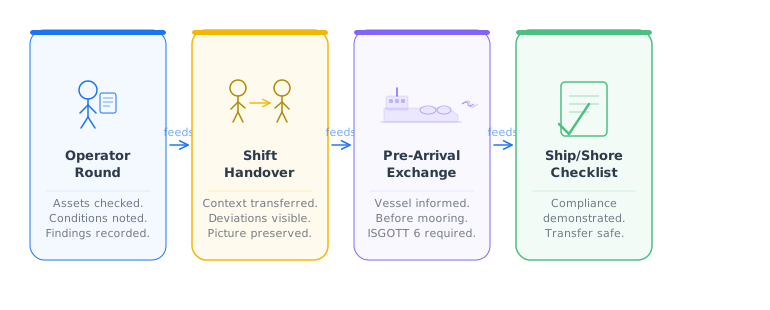 Image 1: How the operator rounds, shifts, handovers, and pre-arrival exchanges
in liquid terminals connect under ISGOTT 6.
Image 1: How the operator rounds, shifts, handovers, and pre-arrival exchanges
in liquid terminals connect under ISGOTT 6.
The operator round
The round is where the operational picture is created. An operator walks the terminal, checks the assets, notes conditions, and records findings. Done well, it is the primary source of real situational awareness across the terminal’s infrastructure.
The round fails as a compliance mechanism not when operators miss findings, but when findings do not travel anywhere useful. A round that produces a paper entry nobody reads before the next shift exists for documentation purposes only.
The shift handover
The handover is where the operational picture is transferred. The outgoing crew passes the current state of the terminal to the incoming crew. Under ISGOTT 6, the picture available for the pre-arrival exchange depends on what the handover preserved. And the handover can only preserve what the round captured.
If the handover relies on verbal communication and individual memory, the pre-arrival exchange will be only as good as whoever is on shift and what they happen to remember.
The pre-arrival exchange
This is where the operational picture is used. The terminal communicates the current state of its operations to the arriving vessel before it moors. ISGOTT 6 places clear emphasis on this exchange happening before arrival. The information must already be structured, current, and accessible.
The quality of that picture depends entirely on what the operator round captured and what the shift handover preserved.
A terminal that produces this from a connected record satisfies ISGOTT 6’s intent, not just its form. A terminal that assembles it at the last moment from separate logs and verbal summaries satisfies the form only.
Why This Is the Right Moment to Address It
ISGOTT 6 has been in circulation since 2020, and many liquid terminals have updated their paperwork and procedures. But the first year of SIRE 2.0 data shows the human factors gap remains the industry’s primary unresolved problem.
For terminals, this creates a specific and time-limited opportunity. The industry is actively discussing why human factors performance is not improving despite better documentation. Terminals that close the gap between their rounds, handovers, and pre-arrival exchanges now will find audits, vetting interactions, and commercial relationships easier to manage. Not because they have added more compliance activity, but because the activity they already have is producing something useful. Connected digital workflows and AI-supported tools are making that shift possible for many terminals, bringing operational knowledge across shifts rather than leaving it dependent on who happens to be present.
Ready to Close the Gap?
If you would like to explore where your liquid terminal currently stands against these requirements, our team works with terminal operators on this question. Reach us at cyzag.com/request-demo.
This article is the first in Cyzag’s series on operational continuity for liquid terminals. The next article examines what that looks like in practice: why most terminal rounds currently fail to build the operational picture ISGOTT 6 requires, and what changes when we connect the round, the handover, and the pre-arrival exchange.
Further reading: A Stolt Tankers Case Study: Scaling CI Across 104 Vessels | Why Problems Keep Coming Back | What Shift Handover Can’t Do Alone |
FAQ: ISGOTT 6 and SIRE 2.0 for Liquid Terminal Operators
The following questions address common concerns about ISGOTT 6 and SIRE 2.0 for liquid terminal operators.
Does ISGOTT 6 apply to our liquid terminal even if we do not handle crude oil?
Yes. ISGOTT 6 covers terminals handling petroleum products, chemicals, and liquefied gases, not only crude oil terminals. If your terminal receives tankers carrying any of these products, ISGOTT 6 is the relevant industry standard for the ship/shore interface.
We completed our ISGOTT 6 checklist update years ago. Do we need to do anything more?
Updating the checklist format was the first step. ISGOTT 6’s requirements go further, specifically around the pre-arrival information exchange and the human factors dimension. The question is not whether your checklist matches the ISGOTT 6 format, but whether the operational picture behind it is genuinely current and structured at the moment it is needed.
Our terminal does not receive SIRE 2.0 inspections. Does this still affect us?
SIRE 2.0 inspects vessels, not terminals. But the ship/shore interface is part of what inspectors assess, and a terminal that contributes to negative observations at that interface affects the vetting record of every vessel that visits. Oil companies and charterers use SIRE 2.0 reports when deciding which terminals their vessels can use. The commercial consequences for the terminal are real, even without a direct inspection.
What is the simplest way to assess whether our terminal has a gap?
Ask one question: if an inspector arrived right now and asked for the operational picture from the last three shifts: what was observed, what was flagged, what decisions were made and why. Could you produce that from a connected record, or would you need to reconstruct it from memory, paper logs, and separate systems? If the answer is the latter, the gap is likely structural rather than circumstantial.
Follow Cyzag on LinkedIn for new articles and stories.