5 Revolutionary Tech Boosting the Industry
This blog explores 5 digital technologies that can empower the industry and take businesses to new levels.
Updated 12 March 2025 6 min read
Technologies in industry are evolving rapidly, transforming how companies tackle today’s toughest challenges. From navigating the European energy crisis to managing fluctuating raw material prices, manufacturers face constant pressure. Moreover, supply chain disruptions, workforce constraints, and shifting market demands add to the complexity.
However, forward-thinking manufacturers embrace new technologies to address these challenges head-on. They are revolutionising their operations, driving sustainability, and pushing industry progress to new heights.
Artificial Intelligence (AI) stands out as a game-changer among these technologies. It’s not just a trend; it’s shaping the future of manufacturing. As advanced analytics and AI continue to make their mark, innovative technologies paired with AI offer even more potential. This blog explores these technologies that, together with AI, can unlock operational excellence and provide a competitive edge in a fast-changing landscape.
Five Technologies that Empower Manufacturers
1. Industrial Ops
Industrial DataOps is a critical software category that helps companies adopt Industry 4.0 by tackling the challenges of vast data processing. As companies generate more data than ever, traditional systems often falter, struggling with excess, unused information. This overload complicates processing, reduces security, and increases vulnerability.
However, Industrial DataOps offers a solution by standardising and contextualising data, addressing complex architecture and integration issues across the enterprise. A robust Industrial DataOps solution typically includes five key capabilities:
-
Data Transformation: This capability analyses and correlates data from various machines and controllers, using standard models to scale and present data to IT applications.
-
OT and IT Integration: DataOps solutions connect seamlessly with industrial devices using proprietary protocols and IT systems via APIs, ensuring compatibility and value across operations and business applications.
-
Information Management: Effective data flow management allows operations teams to identify, enable, disable, and modify data, maintaining control over data flow and conditions.
-
Scale and Security: Industrial data requires high-level security and scalability. Due to its valuable intellectual property, it must be contextualised, quickly delivered, and secured.
-
Edge Computing: Located close to the data source, DataOps solutions enable efficient processing, data governance, analytics, and visualisation at the edge.
HighByte Intelligence Hub exemplifies an Industrial DataOps solution tailored for industrial data modelling, delivery, and governance. It enables manufacturers to securely connect, model, and flow industrial data to IT systems without coding. Deployed at the edge, it merges real-time, transactional, and time-series data into a single payload for consuming applications. The Intelligence Hub accelerates system integration, provides contextualised data for analytics, AI, and ML, and ensures data standards across the enterprise.
2. Time Series Database
A time series database (TSDB) optimises handling time-stamped or time series data. While not new, first-generation time series databases primarily focused on financial data. However, with the rise of sensors, everything inside and outside the company now emits a constant stream of metrics and events. Consequently, the underlying platforms must evolve to support these new workloads—more data points, data sources, monitoring, and controls.
A TSDB is optimised to measure change over time. Fundamental properties include data lifecycle management, summarisation, and the ability to perform large-range scans of numerous records.
InfluxDB, designed for developers, plays a central role in many manufacturing solutions. It provides high-throughput ingestion, compression, and real-time querying of industrial sensor data. Manufacturing and process engineers rely on InfluxDB to collect IIoT sensor data, helping to reduce machine downtime, enhance output, improve safety, and advance predictive maintenance strategies. Furthermore, by integrating and centrally monitoring all IIoT metric data, InfluxDB enables seamless data management on a single platform.
3. Digital Operations Platform
Despite investments in automation and new technologies, manufacturers still face three primary challenges:
-
Manual processes: Daily operations often rely on paper manuals and manual data recording. This leads to inefficiencies, human errors, and difficulty accessing and retrieving data.
-
Information silos: Non-standardised processes hinder compliance and operational improvements. This lack of standardisation restricts information flow, causing data access, analysis, and collaboration delays.
-
Skilled workforce shortage: Experienced workers are retiring, and younger generations are less inclined to join. At the same time, the demand for digital skills has grown. Digitising the shop floor experience can attract new talent.
Digital operations platforms address these challenges by connecting people, processes, and technology. They enhance communication, provide insights, and optimise processes, empowering frontline workers to work smarter and more efficiently.
The Cyzag platform exemplifies this technology by integrating real-time data, processes, tools, and analytics into a central hub for manufacturing. Its user-centric design and intuitive interface boost adoption, while flexible boards and workflows balance standardisation with adaptability.
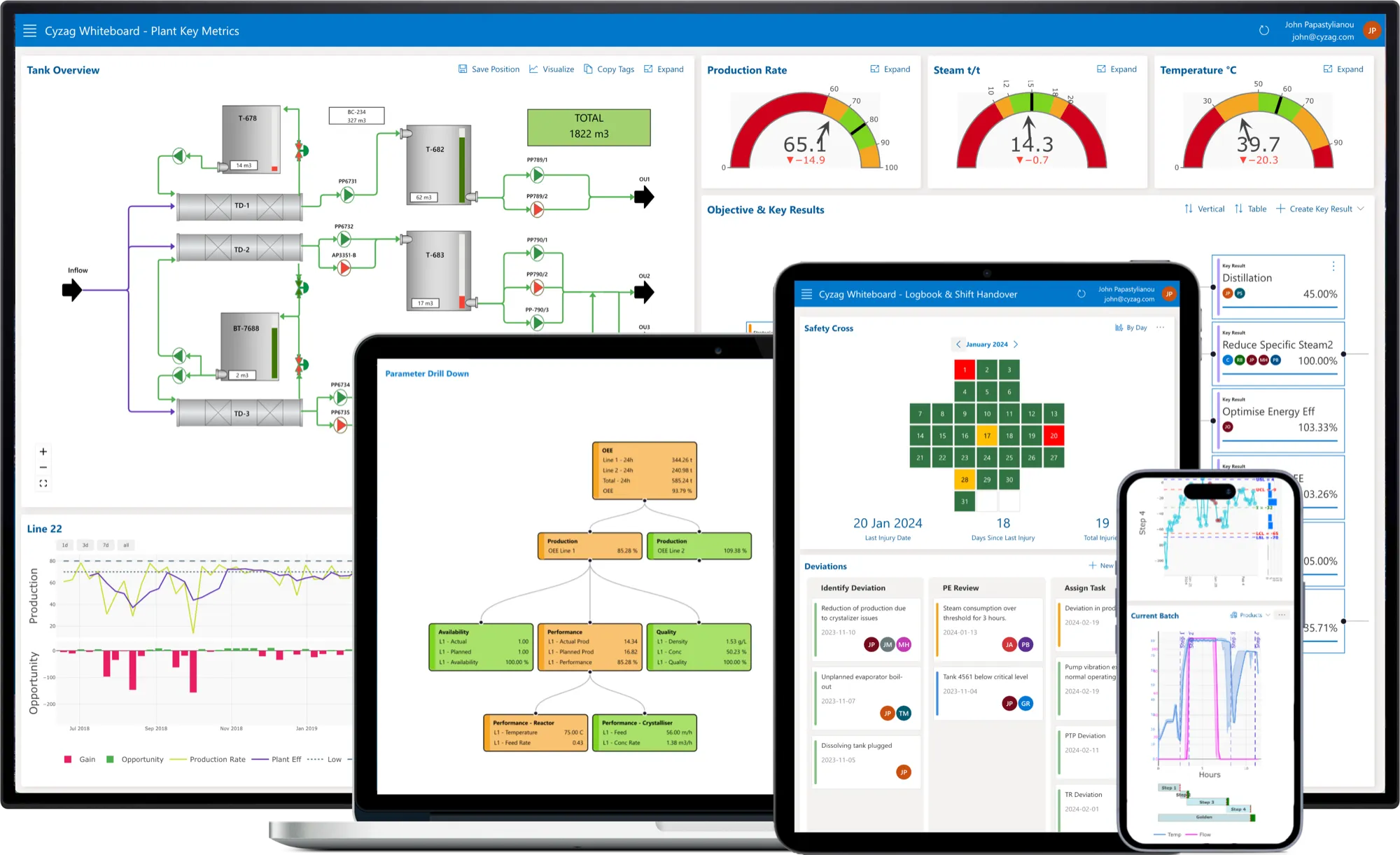 Examples of the Cyzag Platform
One key differentiator of Cyzag’s digital operations platform is its no-code design, which empowers citizen developers. These non-IT professionals, such as Process Engineers, Manufacturing Excellence Managers, and Production Operators, create applications using low-code or no-code platforms. Moreover, they possess deep process knowledge and understand organisational dynamics. Unlike external developers, citizen developers bring firsthand experience, which aligns closely with business objectives.
For example, Nobian, a manufacturing company, successfully implemented Cyzag’s platform, empowering over 550 workers to make real-time decisions within just a few months. This transformation highlights how digital operations platforms enhance productivity and drive business success by engaging the workforce in innovative ways.
4. Predictive Maintenance Software
Predictive maintenance software uses data analytics, machine learning, and artificial intelligence (AI) algorithms to predict equipment failures before they occur. The software identifies patterns and indicators of potential failures by monitoring real-time data from sensors, historical maintenance records, and other sources. This approach allows manufacturers to schedule maintenance proactively, avoiding unplanned downtime and optimising maintenance costs. It also helps extend the lifespan of critical equipment.. Predictive maintenance software helps improve overall equipment effectiveness (OEE) and enhances operational efficiency in industry plants.
Senseye Predictive Maintenance solution from Siemens enables asset intelligence across plants without manual analysis. It helps manufacturers increase productivity, work more sustainably, and accelerate digital transformation across their entire organisation. By combining AI with human insights, the platform automatically generates machine and maintainer behaviour models, directing attention and expertise to where it’s needed most. Senseye integrates seamlessly with any asset, system, or data source, using both existing data and newly installed sensors.
5. Digital Twins
Digital Twins are virtual replicas of physical assets or processes, such as plants, reactors, or equipment. They integrate real-time data from sensors and other sources to create a digital representation that mirrors the behaviour and performance of the physical counterpart. In industry, digital twins provide a deeper understanding, monitoring, and predictive capabilities that can enhance decision-making, maintenance strategies, and overall operational efficiency. Operators or users can use the twin to test scenarios before implementing changes on an accurate scale.
While process simulation software focuses primarily on understanding and optimising processes, digital twins extend their capabilities by incorporating real-time data and creating a dynamic, virtual replica of the physical process.
TwinThread is a cloud-native platform that combines Digital Twins with groundbreaking AI to identify, prioritise, and execute continuous improvement initiatives. It enhances process and asset quality, throughput, reliability, and sustainability. TwinThread automatically discovers data points across networks, gathering information from smart devices to data historians. As it collects and aggregates data, it creates an exact virtual representation of the operating environment. Once the twin is established, a library of pre-built analysis applications offers increasingly insightful views of your automation environment, suggesting specific corrective actions to boost efficiency.
Summary
Integrating new technologies in manufacturing creates a clear pathway toward more collaborative and agile production systems. By adopting and integrating these advancements, the industry can significantly enhance productivity and sustainability, improve efficiency, reduce costs, and accelerate innovation.
However, successfully incorporating new technologies requires more than just adoption; it demands a proactive mindset, continuous investment in R&D, and a willingness to adapt to change. As manufacturers embrace these new possibilities, they are not just keeping up—they are positioning themselves to reap the immense benefits and drive positive impacts across their operations.
Follow Cyzag on LinkedIn for new articles and stories.