How Digitalisation Saved €150K and Improved Work Processes 2X
Learn how a manufacturer saved €150K annually by streamlining operations across 7 sites using Cyzag's no-code platform for digitalisation.
Updated 11 February 2026 10 min read
To maintain competitiveness, a leading chemical manufacturer (referred to as The Company) addressed the challenge of fragmented data systems and inefficient operations across 7 sites in 6 countries. These sites involved around 1,000 people, including operators, process engineers, plant managers, and improvement teams. By embracing digitalisation in manufacturing, the company achieved €150,000 in annual savings in their first use case and saw their work processes improve 2x. They leveraged Cyzag’s no-code platform to eliminate data silos, standardise work processes, and provide frontline teams with real-time data. This digital transformation set the stage for scalable, data-driven operations that enhanced decision-making, improved transparency, and fostered stronger team collaboration.
Let’s explore how the company accomplished this transformation and the impact it made on their operations.
The Challenge: Streamlining Operations and Enhancing Process Analytics
The manufacturer recognised a significant challenge in its operations: existing data silos were hindering efforts to scale efficiently and remain competitive. Fragmented digital tools, Excel sheets, and paper-based processes shaped the operational infrastructure across their chemical plants, creating complex information silos. This landscape of locally managed databases and files created bottlenecks in daily operations, reducing efficiency and concealing opportunities for improvement. Furthermore, the management and governance of day-to-day operations became increasingly difficult as these silos persisted.
To address this challenge, the company needed to implement effective change management, particularly in the chemical sector, where IT systems maturity varied across different plants in multiple countries. The chemicals company understood the need to navigate these differences to ensure a successful transition and scalable solution.
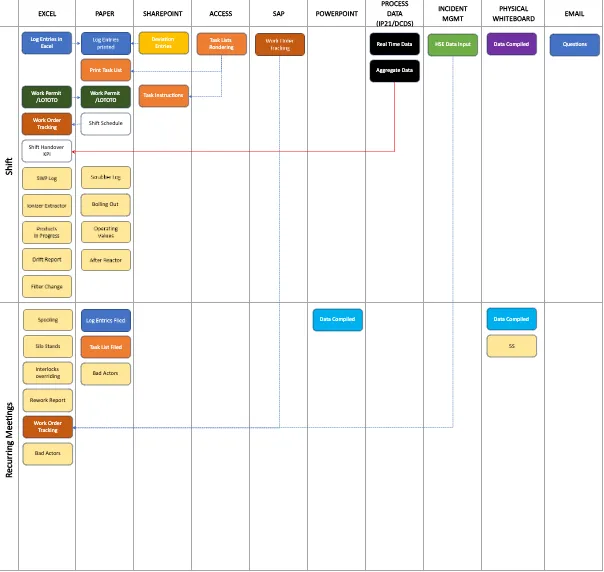 BEFORE EXAMPLE: Data silos and manual data flows hinder efficient operations.
Integrating new use cases into the company’s established manufacturing processes proved difficult in such a fragmented environment. The presence of numerous tools and competing “versions of the truth” complicated efforts to introduce new solutions. Each new use case required adopting new tools, training staff, and ensuring the new workflows could be seamlessly integrated into daily routines.
According to the Product Owner MES, focused on Operational Excellence– Industrial Digitalisation, “the idea was to establish a common platform where different people within operations could access information to take action.”
The Solution: Recognising Digitalisation’s Potential with Cyzag
2.1 Setting the Vision
Recognising the potential of digitalisation in manufacturing, the company set a clear goal to create a unified platform that would transform operations across its plants before 2025. They wanted to achieve this by managing information and data across the shop floor to enable operational excellence.
This web-based platform would enable users within and outside the plant control rooms to analyse, collaborate, and exchange information to carry out frontline tasks effectively. The solution would aim to be intuitive and user-friendly, thereby enabling shop floor personnel to identify and implement improvements proactively. More than just a tool, it serves as the cornerstone of a collaborative ecosystem that actively drives day-to-day manufacturing performance.
To make this a reality, the chemicals company sought a partner to develop a comprehensive solution to address its operational challenges and enhance process analytics. The evaluation criteria included:
-
Extensive functionality;
-
Good user experience;
-
IT robustness and an easy administration tool;
-
Integration and synergies, focusing on information flow;
-
Flexibility of platform development to the Company’s needs and creation of personalised use cases;
-
High focus on operators.
The Company also evaluated vendors on their competence, coaching ability, platform robustness, and overall costs, including capex, fixed costs, and scalability.
2.2 Finding the Right Partner
Among twelve other vendors, the chemicals company selected Cyzag following a market-wide scan for digital solutions. The Cyzag platform adopts a no-code approach, enabling teams to intuitively construct and implement custom use cases through its whiteboard philosophy. Cyzag was chosen due to its adaptability and emphasis on user-centric design. The importance of Cyzag’s flexibility in configuration, allowing quick adjustments based on specific user needs, was a differentiator.
Just as a whiteboard in a control room is a focal point for collaboration and innovation, this philosophy centralises disparate data streams into a singular digital workspace, integrating tools that streamline and centralise daily routines and activities. Within this space, a variety of widgets can be combined to forge tailored use cases. The platform facilitates a comprehensive, role-based environment where rich, contextual data is seamlessly integrated with real-time plant information. This fusion is designed to solidify daily workflows while also embedding real-time manufacturing process analysis into daily routines.
Their search for a digitalisation partner extended beyond finding a mere platform provider. They sought a collaborator with a proven track record in delivering digitalisation in manufacturing solutions and a commitment to engaging and empowering their workforce. Cyzag distinguished itself in this search. The Product Owner MES remarked on the distinctiveness of the Cyzag team’s approach:
“One of the things that we are pleased with is the level of competencies and capabilities in the Cyzag team. It’s a much, much higher level, much more convincing than other providers [we evaluated] who were mostly engaging with us in the way that they were trying to sell a tool only. But since the beginning of discussions with Cyzag, the team were there to really focus on achieving the result and the transformation, not just selling a tool.”
2.3 Initiating Proof of Concept
Together, the two companies embarked on a proof-of-concept project in 2022 at one of The Company’s sites. After just three weeks of setup, The Company gave employees access to the Cyzag platform, creating a single source of truth for use cases like task management, disturbance tracking, and log entries. This first step aligned and unified a significant portion of shop floor tasks, saving two hours per shift.
With the proof of concept’s (POC) success, the next step would be planning and executing the full implementation.
2.4 Going for the Full Implementation
The implementation timetable started in February 2023. The goal was to implement and evolve the solution across 7 sites distributed in 6 countries, involving around 1000 people, including operators, process engineers, plant managers and improvement teams.
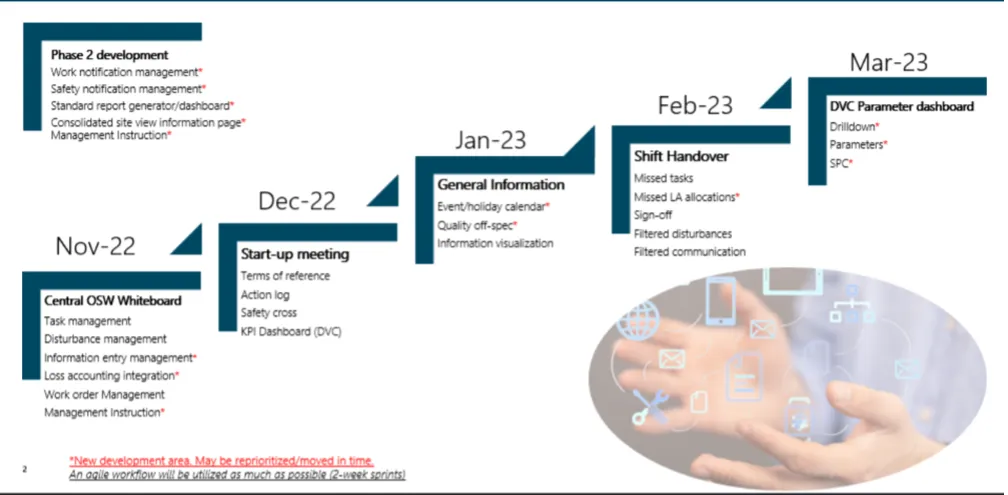 The Company’s short-term development plan.
After finalising the plan, the team quickly began implementing tools that supported real-time decision-making and enabled the identification and execution of continuous improvement opportunities. The implementation followed an agile development cycle, following a pre-defined list of standard use cases.
The Company’s team assumed complete control over the implementation process and the crafting of use cases, with Cyzag providing support from the sidelines. Leveraging the no-code capabilities of the Cyzag platform, they were able to quickly iterate and test various ideas. Integral to this process was the feedback from operators on the ground; their insights were promptly integrated by their central deployment team. This approach not only accelerated the implementation but also fueled user engagement and enthusiasm. By incorporating the users’ perspectives directly into the development cycle, they achieved a significant uptick in user engagement.
The team is also able to streamline the deployment process by creating templates from successful use cases, facilitating swift deployment across new locations. While these templates provide a robust starting point, the platform’s flexible design allows for extensive customisation, accommodating the unique requirements of each specific implementation.
Results: Achieving Operational Efficiency and €150K in Annual Savings Through Digitalisation in Manufacturing
Initiating the implementation process, the primary goals were to standardise work processes across all manufacturing plants and focus on scaling operations efficiently. The developed use cases concentrated on optimising shop floor routines, encompassing shift logbooks, handovers, deviation logs, recurring task management, visual boards and performance meetings.
The central Operational Excellence team at the Company spearheaded the implementation of standard use cases, ensuring a cohesive approach, while plant-specific use cases were tailored and developed by individual plants. They included aligning shop floor activities, streamlining work processes and consolidating multiple tools into one to minimise burdens and complications for operators. Here are five different benefits they found:
1. Standardised Work Processes:
The central team discussed and standardised minimum operational routines for every plant, aligning daily operations and improving transparency and governance.
2. Daily Task Management:
The platform significantly enhanced daily task management, offering operators an intuitive interface and helping them organise routines efficiently. Planning and tracking activities helped supervisors and managers work smoothly, saving time and being up to date with the work. The elimination of communication barriers improved the overall workflow.
“Our work processes are 2x better. Before when we used paper, operators would write something down and then forget it or the field operators wouldn’t have paper to hand. Now the operators have the Cyzag tool for everything so they can get the information easily and give it to the other operators.”
Operations Manager
3. Custom Use Case Deployment:
Besides the standard work process defined by the central team, every plant could create custom use cases tailored to their specific processes. An example of it is related to the ion exchanger operations. Two of their sites identified an opportunity to improve ion exchanger tracking parameters, flashing schedules, and other critical information. With the help of Cyzag’s platform, they could improve the process stability, reducing issues related to process deviations and contributing to overall efficiency.
“One of the great positives, and this is some of the good feedback that we’ve gotten about the tool, is we used to have several different information scattered amongst Excel and in paper format. We’ve made custom tabs within the Cyzag tool to track this information, so our operators are very happy to have it all in one place now.”
Operations Superintendent
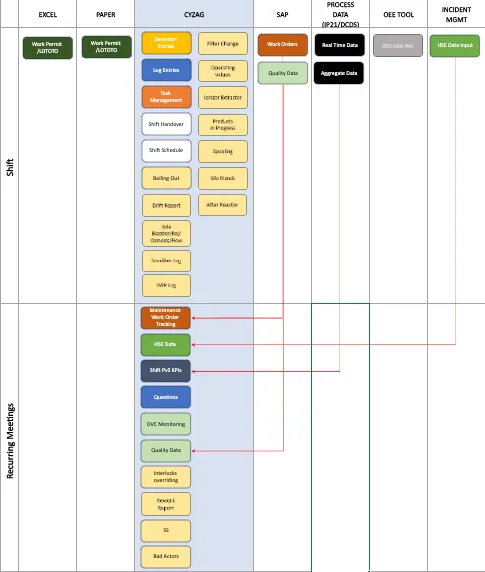 AFTER: After Cyzag was implemented
“The whole philosophy with Cyzag is based on widgets and the possibility that you can easily change layouts and appearance, select fields and so on makes it very, very configurable”
Product Owner MES, focused on OPEX – Industrial Digitalisation.
4. Collaborative Workspaces:
Cyzag’s platform introduced collaborative workspaces where operational teams could create dedicated use cases for various plant areas. This enabled real-time collaboration, replacing cumbersome paper and Excel-based systems. At one of their plants, the operators identified a problem of leaking oil in certain equipment. Communicating across shifts using the disturbance list solved the problem and revised the setting, which also applied to other pieces of equipment.
Users are engaged and committed to using the Cyzag platform to its best.
“I really like the tool. Finally, we have a common way of working, we have a way of visualising data for operators. They know where to look at, and they’re interested in it. And I like the support we have from Cyzag, trying to meet our demands on technical issues and so on. So, it’s really good.”
Continuous Improvement Engineer & Team Lead
5. Cornerstone for Continuous Improvement:
A foundational aspect of the Cyzag platform is its dedication to ingraining continuous improvement within daily routines. It achieves this by presenting data in an easy-to-consume way that encourages easy interpretation and informed decision-making. The Company implemented a variable cost control (steam consumption) use case, seamlessly integrating it into operators’ daily routines. This integration marks a shift from viewing improvement measures as separate tasks to recognising them as part of daily operations.
“Now that it (DVC) is integrated with the operator task lists, the operators are following it, and it has shown 150k EUR annual saving in our first use case.”
Continuous Improvement Engineer & Team Lead
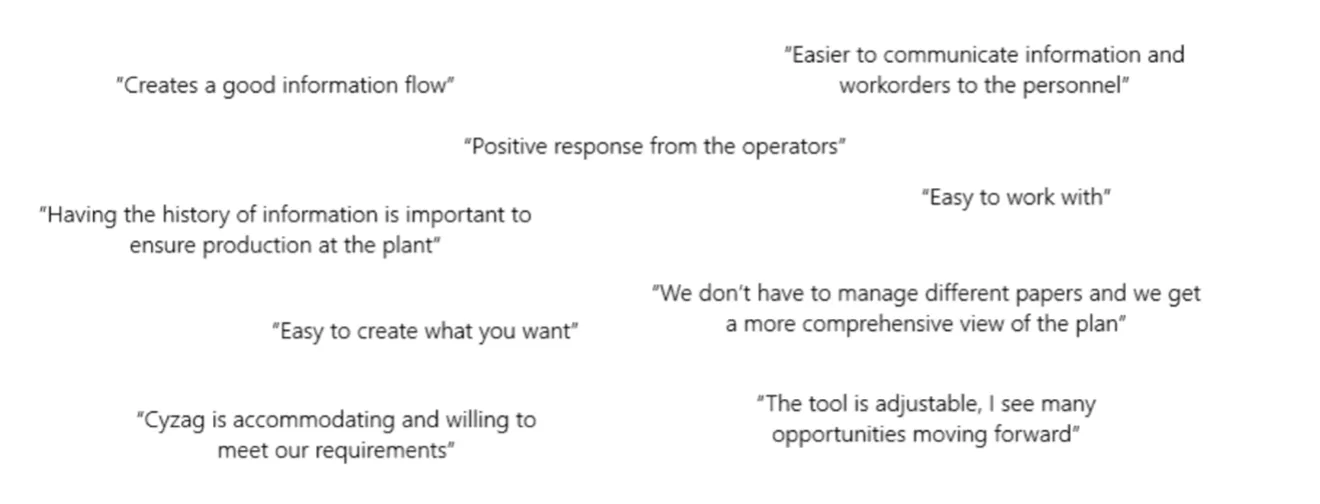
Summary
In conclusion, the implementation of the Cyzag platform at The Company has proven to be a transformative journey. Cyzag addressed the complex challenges of streamlining operations and scaling operations efficiently. The clear vision set by The Company paved the way for a partnership with Cyzag.
Despite the initial barriers, a unanimous agreement emerged – the investment in time and effort for change management is indispensable. Recognising the human element in change management and using transparent communication fostered a culture of innovation while preventing disruptions.
Success in standardising work, improving task management, and enabling real-time collaboration highlights the value of a well-executed digital transformation.
Individual sites could create custom use cases alongside standard ones, giving them autonomy, engagement, and ownership. Cyzag’s platform, with configurable widgets and collaborative workspaces, enabled tailored solutions for specific plant needs, improving efficiency. This contributed to process stability and continuous improvement. Reducing variable costs and boosting asset performance on the factory floor is a key challenge that Cyzag transforms.
As the company experiences the positive outcomes of the Cyzag platform, it becomes clear that scaling operations efficiently requires more. Achieving this goal demands more than just a robust digital tool. Instead, it needs a strategic approach prioritising people, communication, and flexibility. The dedication to continuous improvement and innovation demonstrated by the Company offers valuable insights for organisations undertaking comparable digitalisation initiatives.
“We have accomplished something really good, and we’re just at the beginning, where they all see the potential. People who have started to use it, want to take the next step”
Global Continuous Improvement Manager
Follow Cyzag on LinkedIn for new articles and stories.