Understanding OEE and It’s Importance in Manufacturing
Are you finding it challenging to identify and resolve production losses? Let's get back to basics on OEE.
Updated 28 April 2026 5 min read
Are you finding it challenging to identify and resolve production losses? Overall Equipment Effectiveness (OEE) can significantly impact profitability and competitiveness by pinpointing equipment-based losses. However, a common mistake is solely focusing on calculating and reporting the OEE score, leading to a loss of perspective and effectiveness. OEE numbers should serve as a means to drive action and improvement within plant teams.
Let’s delve back into the basics and explore what OEE is and why it matters.
What is Overall Equipment Effectiveness?
Overall Equipment Effectiveness (OEE) is a metric designed to assess and eliminate production losses, promoting efficiency and productivity daily. The three OEE components— Availability, Performance, and Quality—help identify where losses occur, providing clarity on areas for improvement.

The Need for OEE
In the face of challenges like high energy prices, inflation, supply chain issues, and climate change, the process industry must enhance its performance. OEE plays a crucial role in identifying equipment-based losses, impacting profitability and competitiveness.
Why Does Overall Equipment Effectiveness Matter?
OEE enables producers to increase asset performance, production output, and revenue. It optimises resource utilisation, reduces waste and operating costs, avoids unnecessary capital projects, and enhances product quality, leading to higher customer satisfaction and loyalty. While a world-class OEE score is over 85%, the average for the process industry is between 60% and 85%, leaving room for improvement.
Warning: Focus on Action and Improvement
While a high OEE score is desired, the emphasis should not be solely on calculating and reporting the score. The key is for OEE numbers to drive action and improvement within plant teams.
The OEE Components Explained
Availability
OEE availability is the ratio of Run Time to Planned Production Time. The most common losses related to it are planned and unplanned downtimes. Lack of demand and seasonality are not considered here. OEE considers only the planned production time.

Performance
The actual speed of the equipment compared to its theoretical maximum. The most common losses related to it are reduced speed and minor stops.

Quality
The percentage of products that meet the required quality standards. The most common events here are production rejects and start-up rejects.

How Does OEE Work?
Identifying and removing production losses involves a 3-step process:
-
Measure it (visibility)
-
Allocate it (transparency)
-
Improve it (actionability
Consistent work with OEE allows teams to set and resolve high-priority losses, utilising methodologies like Short Interval Control (SIC) for effective decision-making.
Process Industry Aspects
OEE is essential in both batch and continuous processes within the process industry. However, it’s crucial to assess whether OEE is the best metric for your plant.
-
Batch Processes: Focus on time and meeting specific batch completion targets, measuring downtime, performance, and quality for each batch step/phase.
-
Continuous Processes: Emphasis on volume and achieving specific targets, measuring downtime, performance, and quality for continuous production.
Consideration of TEEP (Total Effective Equipment Performance) becomes essential for continuous processes running at a maximum rate, where only good material is produced.
OEE and Digitalisation
Employing advanced digital tools, such as the innovative Cyzag platform, represents a pivotal leap forward in optimising the Overall Equipment Effectiveness (OEE) process. The platform introduces a seamless integration of cutting-edge technologies that revolutionise traditional approaches to production monitoring and enhancement.
Automation of Calculations
Cyzag automates the intricate calculations involved in determining OEE scores, transcending the limitations of manual data collection. By leveraging sophisticated algorithms, the platform ensures accurate and real-time computation of OEE metrics, freeing up valuable time for plant personnel to focus on strategic decision-making.
Real-Time Accessibility
One of the standout features of the Cyzag platform is its provision of real-time accessibility to critical production data. This instantaneous access empowers stakeholders at various levels of the organisation to make informed decisions promptly. Managers can monitor operations remotely, enabling swift responses to emerging issues and fostering a proactive approach to production management.
Visualisation of Trends
Cyzag goes beyond basic data representation by offering comprehensive visualisations of production trends. Through intuitive graphs and charts, users can effortlessly identify patterns, fluctuations, and anomalies in production performance. This visual analysis not only enhances data interpretation but also aids in forecasting future trends, allowing for preemptive measures to be implemented.
Generation and Classification of Production Losses
The platform’s robust capabilities extend to the automatic generation and classification of production losses. Cyzag systematically identifies and categorises the various types of losses, providing a granular understanding of where and why inefficiencies occur. This detailed breakdown serves as a roadmap for improvement initiatives, directing attention to specific areas that require targeted interventions.
Facilitation of Root-Cause Problem-Solving
Cyzag acts as a catalyst for efficient root-cause problem-solving within the production ecosystem. By streamlining the identification and analysis of underlying issues contributing to production losses, the platform equips plant teams with the insights needed to implement corrective actions swiftly. This proactive approach enhances the overall resilience and adaptability of the production process.
A Practical Example
The Cyzag platform supports OEE for every product in continuous and batch processes. Here we have an example of OEE tracking and categorisation for continuous production:
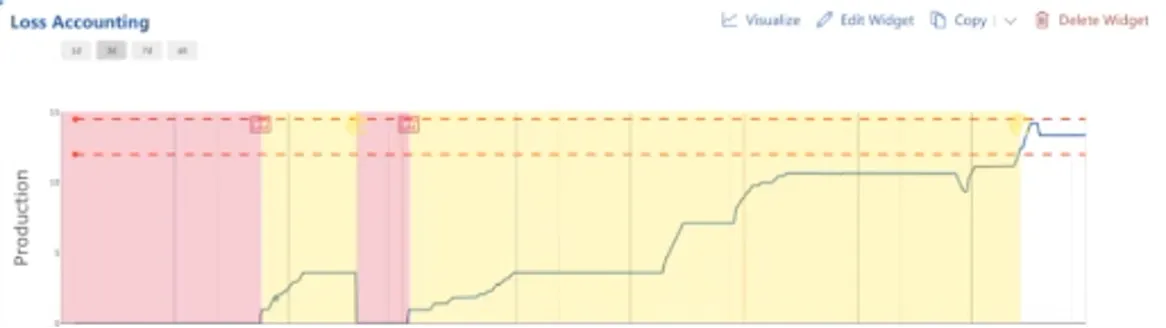
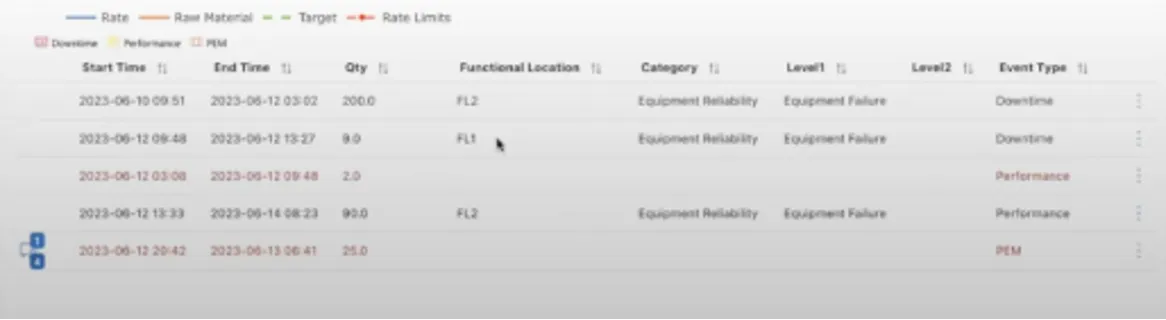 Loss accounting within the Cyzag platform.
Here we have an example of OEE tracking and categorisation for batch production:
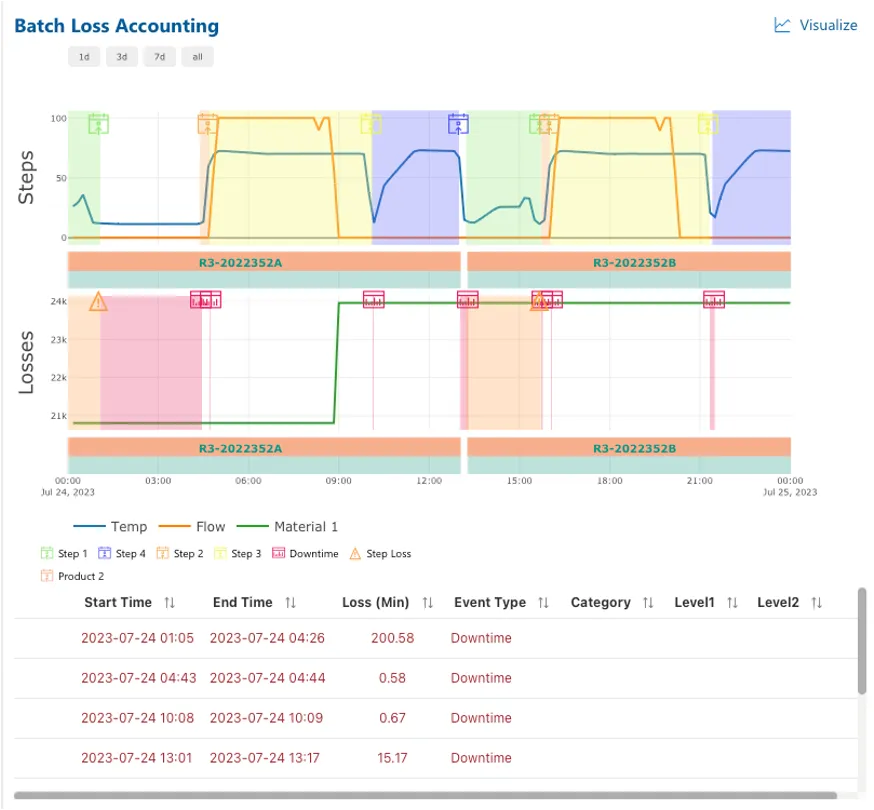 Batch loss accounting in the Cyzag app.
Summary
In conclusion, the integration of advanced digital tools like the Cyzag platform marks a significant stride towards redefining the landscape of Overall Equipment Effectiveness management. By seamlessly incorporating cutting-edge technologies, Cyzag not only automates complex calculations but also provides real-time accessibility, comprehensive trend visualisation, and systematic generation and classification of production losses. Moreover, it catalyses efficient root-cause problem-solving, empowering plant teams to implement corrective actions promptly.
As industries navigate the era of digital transformation, Cyzag emerges as more than just a tool; it becomes a pivotal ally in maximising the efficiency, reliability, and profitability of production processes. Its multifaceted capabilities not only streamline day-to-day operations but also foster a culture of continuous improvement by promoting data-driven decision-making.
Book a personalised demo today to see how digitalisation through OEE can empower your teams, or read our in-depth OEE whitepaper for further insights.
Follow Cyzag on LinkedIn for new articles and stories.