Tribal Knowledge in Operations: The Hidden Cost of Losing It
Tribal knowledge in operations rarely lives in any system. Discover what happens when it becomes unavailable and how to retain it.
11 min read
In most asset-intensive operations, such as process manufacturing, liquid terminals, energy, and chemicals, there is always someone who simply knows. They know which pump behaves differently in summer, why a valve position was changed years ago, and how a process behaves when conditions drift slightly outside the expected range. This is tribal knowledge in operations. It is real, valuable, and often the difference between a shift that runs smoothly and one that does not. The problem is not that this knowledge exists. The problem is where it lives. And how it is structured. Because the real value is not just in what people know, but in how they connect situations, recognise patterns, and understand cause and effect over time.
Why Tribal Knowledge in Operations Is More Critical Than It Appears
The scale of the exposure is growing. McKinsey research shows that the proportion of manufacturing employees over 55 has more than doubled in the past 20 years, with retirement rates surging and institutional knowledge leaving with them.
But focusing only on retirement misses the broader picture. Knowledge becomes unavailable every day, not just when people leave, but when they are off shift, on holiday, covering a different area, or simply not present when a decision needs to be made.
In most 24×7 operations, tribal knowledge has quietly become part of the infrastructure that sustains continuity. It fills the gaps between what systems capture and what operations actually require to run reliably. This knowledge is not documented in any structured way, nor embedded in any system. It exists because specific people have accumulated it through direct, repeated exposure to specific conditions.
What Actually Gets Lost When Knowledge Is Not Available
This happens gradually and without any deliberate decision. A process performs better than the documented procedure would suggest because an experienced operator applies judgment that was never written down. A workaround introduced under pressure becomes standard practice without ever being formalised. An asset behaves in a way the system flags as normal, but an experienced operator reads it as an early warning.
None of this is unusual. It is how complex operations function in practice. The concern is not that experienced operators carry knowledge. It is what happens when that knowledge is not available at the moment it is needed.
In those moments, operations are not just missing information. They are missing context. The cause and effect behind what they are seeing. How the situation is likely to develop, what similar conditions have led to before, and what risks or outcomes sit just beneath the surface.
That directly affects how decisions are made. Teams either slow down to reduce risk, or move forward with partial understanding. Both have a cost.
What Tribal Knowledge in Operations Actually Looks Like
The term “tribal knowledge” is often used loosely. In operations, it does not refer to informal habits or undocumented procedures. It is the result of repeated exposure and pattern recognition. It lives in how people interpret situations, not in something they can simply write down on request.
Procedures and training materials preserve what should happen under normal conditions. They do not preserve how experienced operators recognise deviations, connect current conditions to past events, or make decisions under uncertainty.
That distinction matters.
When knowledge is held by individuals rather than by the operation, it creates a continuity structure that is invisible until it fails. Day to day, everything works because the right people are present. The knowledge is available, even if it is not visible. The gaps only become apparent when something changes.
The most fragile operational infrastructure is the kind you cannot see on any diagram.
When Operations Lose Tribal Knowledge: Three Moments The Gap Appears
The dependency tends to stay invisible until something disrupts it. Three situations reliably expose it.
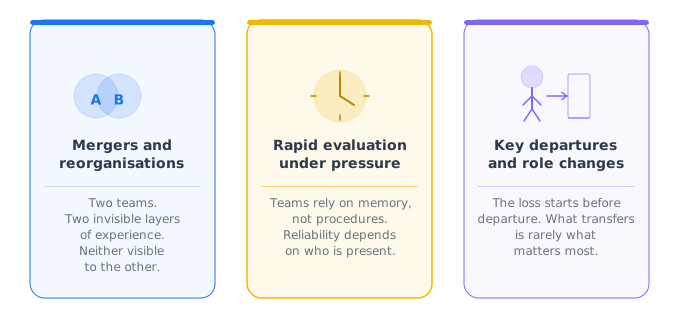 Image 1: Three moments exposing the same structural condition: knowledge that lives in people, not in the operation.
1. Mergers and Reorganisations
When two operations come together, reporting lines and procedures align on a timeline. Operational knowledge does not. Each team carries years of experience with specific assets and informal practices that are largely invisible to the other, while the people who hold that knowledge are busy managing the transition itself. Two operations can work side by side for months while still relying on separate, invisible layers of experience.
2. Rapid Evaluation Under Time Pressure
When operations face a rapid assessment, like a new capacity, a configuration change, or an expanded scope, teams draw on experience, not procedures. This works well when the relevant knowledge is present. It becomes a risk when the people who hold it are already stretched, or when the scenario touches areas where experiential depth is thinner than it appears.
This is also where the impact on decision speed becomes clear. Without accessible context, teams either pause to validate assumptions or move ahead with less confidence in the outcome.
3. Key Departures and Role Changes
The loss rarely begins at the moment of departure. It begins when the organisation knows a change is coming but has not found a way to transfer what that person knows. Asking them to document it typically yields a procedural summary rather than operational reasoning. And that’s because that reasoning is embedded in practice rather than in anything easily articulated.
Why Standard Approaches to Tribal Knowledge Retention Fall Short
Most organisations respond to this challenge with familiar approaches: documentation initiatives, knowledge transfer sessions, mentoring programmes, and succession planning. These are useful and address important aspects of the problem.
But they tend to treat knowledge as a content issue: identify it, extract it, store it. In operations, much of the knowledge does not behave this way.
Pattern recognition built through repeated exposure resists extraction. Interviews capture fragments. Structured sessions miss context. Documentation captures what can be articulated, not necessarily what is most operationally significant.
And they rarely capture how situations connect over time. They record events, but not how those events influence what follows, or how similar conditions should be interpreted in future.
Timing also matters. Knowledge transfer often happens late, under pressure, focused on visible knowledge rather than embedded judgment. The most critical knowledge is often the least likely to transfer effectively.
The result is that most operations remain more dependent on individual memory than they intend to be.
Why Continuous Capture Matters More Than Periodic Transfer
Retaining tribal knowledge is not about improving documentation at the end of a tenure, or preparing for a single event like retirement. It requires capturing context continuously, as part of daily work.
When knowledge is captured at the moment it is created, it retains its context. The reasoning behind a decision is still clear. The conditions are still visible. When capture is delayed, that context disappears, leaving a simplified version that is often less useful when it matters.
Capturing context also means capturing how decisions were shaped and what outcomes they were intended to influence. Not just what happened, but how and why it unfolded that way.
What This Looks Like in Practice
Consider a terminal operation asked to evaluate additional storage capacity within a tight timeline. The team draws on what it knows: prior configurations, known constraints, asset behaviour under specific conditions.
The assessment moves quickly. Decisions are made. Most of them are sound.
But one area involves an asset managed by a team that has since been reorganised. The operational reasoning behind certain configuration choices — why that sequence, under those conditions — was never documented. The people who made those decisions are no longer in those roles. The data exists. The decision trail does not.
And critically, the logic behind those decisions is missing. What conditions led to those choices, and what they were designed to prevent or enable, is no longer visible.
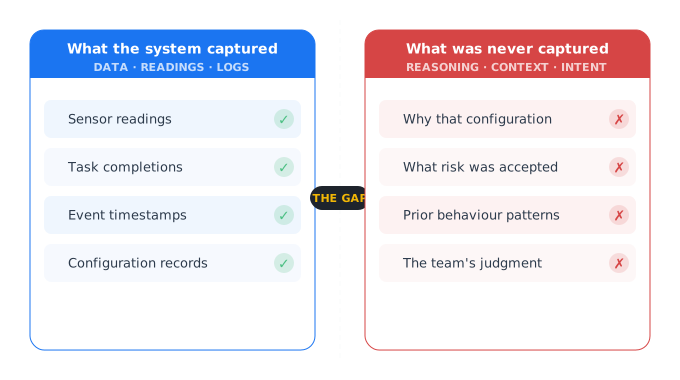 Image 2: The data was there. The decision trail was not.
The evaluation completes on time. Three months later, a condition develops that the original team would have anticipated. The knowledge needed to flag it earlier was in the operation. It was simply not accessible to the people who needed it.
How Operations Can Stop Losing What Their People Know
The dependency is usually visible before a crisis forces it into view. If certain areas of the operation feel less certain when specific people are absent, if onboarding consistently takes longer than procedures would predict, or if post-incident reviews repeatedly surface the finding that someone knew, but it was not documented, the issue is structural, not circumstantial.
The argument is not about replacing the judgment of experienced operators. It is about where the results of that judgment live.
When an operator notices something significant, adjusts a process for a reason, or connects a current condition to a past event, that reasoning has value beyond the moment it occurs. If it remains in that person’s memory, its value is limited by their availability. If it is captured, it becomes part of the operation.
This changes how continuity works. The incoming shift no longer depends on what the previous shift remembers to mention. An operator covering an unfamiliar area does not need to start from first principles. A team managing an expanded scope gains access to accumulated context, not just the people present at that moment.
What the Right Tools Actually Do
An operator notices that a reactor is running warmer than expected. In a conventional logbook, they record the reading and move on. In a platform designed for continuity, they log the entry, categorise it, set the priority, and record why they decided to keep running rather than escalate. That reasoning is what the next crew needs and what an investigation needs three weeks later if the condition returns.
When deviations occur, structured analysis connects the event to its explanation, such as a 5-Why, an Ishikawa diagram, or a similar form. Inspection rounds follow the same logic, capturing observations together with context. Over time, this builds a traceable operational history that is shared and searchable.
When someone asks whether a condition has occurred before, the answer includes not just previous instances but how each was handled and why.
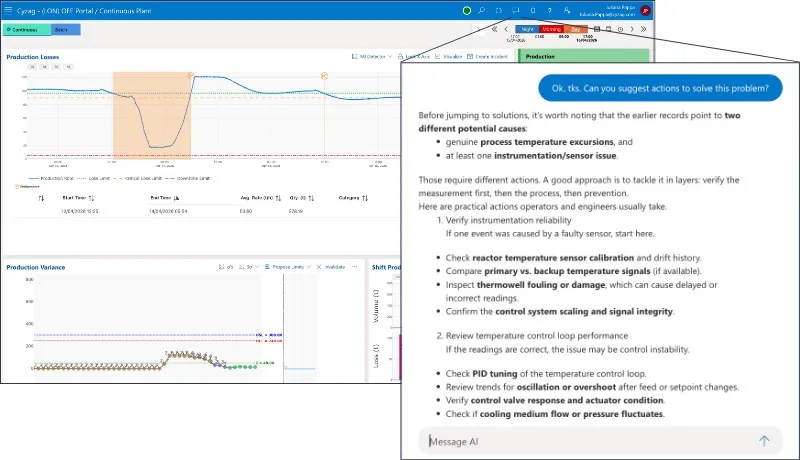 Image 3: When reasoning is captured at the moment it occurs, it becomes part of what the operation knows, not just what one person remembers.
The question worth asking of any system is not whether it records activity, but whether it connects what happened to why it happened and makes that accessible to the next person who needs it. It should not only capture tribal knowledge, but also structure it to preserve cause and effect relationships.
Final Thought
Retaining what people know is not primarily a technology question. It is a design decision.
Technology and AI enable capture, connection, and retrieval. But the underlying question is whether the operation is structured so that knowledge survives beyond the individuals who hold it.
That is a different question from how to retain experienced staff. And it leads to a different answer.
Because the goal is not just to preserve knowledge. It is to preserve an understanding of cause and effect. How the operation behaves, how decisions influence outcomes, and how to act with speed and confidence when conditions change.
Ready to Stop Losing What Your Operation Knows?
Explore how your operation can capture not just what happens, but why it happens, preserving tribal knowledge and the cause and effect relationships that drive better decisions. Our team is available for an exploratory conversation. Start the conversation.
This article is part of Cyzag’s Operational Continuity Series. The previous articles explore where continuity breaks at shift handover and why the same problems keep returning in 24×7 asset-intensive environments. The next article examines why inspections capture conditions but rarely build memory, and what that costs over time.
Further reading: Where Continuity Breaks in Daily Operations | AI in Manufacturing: How It’s Solving the Ageing Workforce Gap | What Shift Handover Can’t Do Alone |
FAQ: Tribal Knowledge in Operations
The following questions address common concerns about tribal knowledge in operations.
Is this only relevant when operations are going through a merger or restructuring?
No. The dependency exists in stable operations too. Mergers make it visible faster, but operational context that lives in individuals rather than in systems is present in most 24×7 environments regardless of structural change.
We have a knowledge management system. Does that address this?
It depends on what it captures. Most knowledge management systems store documents and procedures. What they do not capture is operational context: how conditions relate to each other, how situations have developed over time, and the reasoning behind decisions. In other words, they rarely preserve cause-and-effect relationships. That kind of knowledge needs to live in operational workflows, not in a separate repository.
Is this a problem that grows over time, or does it appear suddenly?
Both, but in a specific sequence. The dependency builds gradually, often over years, as experienced people accumulate knowledge that no system preserves. It appears suddenly when something changes: a reorganisation, a departure, a rapid evaluation under pressure. The reason it feels sudden is that the gap was already there. The disruption just made it visible. This is also why organisations are often caught off guard; operations were running well, so the structural fragility was never apparent until it was tested.
Why is capturing cause and effect relationships more important than simply recording events?
Because events on their own do not guide action. Knowing that something happened is not the same as understanding why it happened or what it is likely to lead to next. In operations, value comes from recognising how conditions connect over time. When cause-and-effect relationships are not captured, teams are left to interpret situations from scratch, often under pressure. When they are, decisions become faster, more consistent, and less dependent on individual experience, because the operation itself retains the logic behind what it has learned.
Does digitalising operations solve this problem?
It creates the conditions for solving it. A system that records events builds a log. A system that connects what happened to why it happened and makes that retrievable across shifts and teams builds operational memory. The design intention is what determines which one you have.
Follow Cyzag on LinkedIn for new articles and stories.