Why Digital Pilots Fail to Scale in Asset-Intensive Operations (5 Critical Barriers)
Discover the 5 critical barriers preventing digital pilots from scaling in energy and asset-intensive operations.
7 min read
Digital pilots frequently succeed in controlled environments but fail to scale across asset-intensive operations. This article explains the five structural barriers that prevent pilot-to-production success, including shift adoption, data fragmentation, process misalignment, integration friction, and weak change governance.
The Pilot-to-Production Problem
Pilot-to-production gap: The failure of successful pilot projects to achieve enterprise-wide adoption and deliver measurable business value at scale across distributed, asset-intensive operations.
Across energy and asset-intensive operations, from offshore platforms and refineries to chemicals plants, oil & gas terminals and maritime fleets, digital pilots succeed, then stall.
One site delivers results. Leadership approves scaling. Momentum slows. The pilot never goes into production.
A McKinsey Research found that 70% of manufacturers are stuck in “pilot purgatory”, unable to scale digital innovations beyond initial experiments. In 24/7, safety-critical environments with legacy Operational Technology (OT) infrastructure, this delay carries real operational cost. Every month spent in pilot mode means fragmented workflows, repeated deviations, and operational context that fails to carry forward between shifts, sites, and systems.
This isn’t a technology problem. It’s a scaling problem.
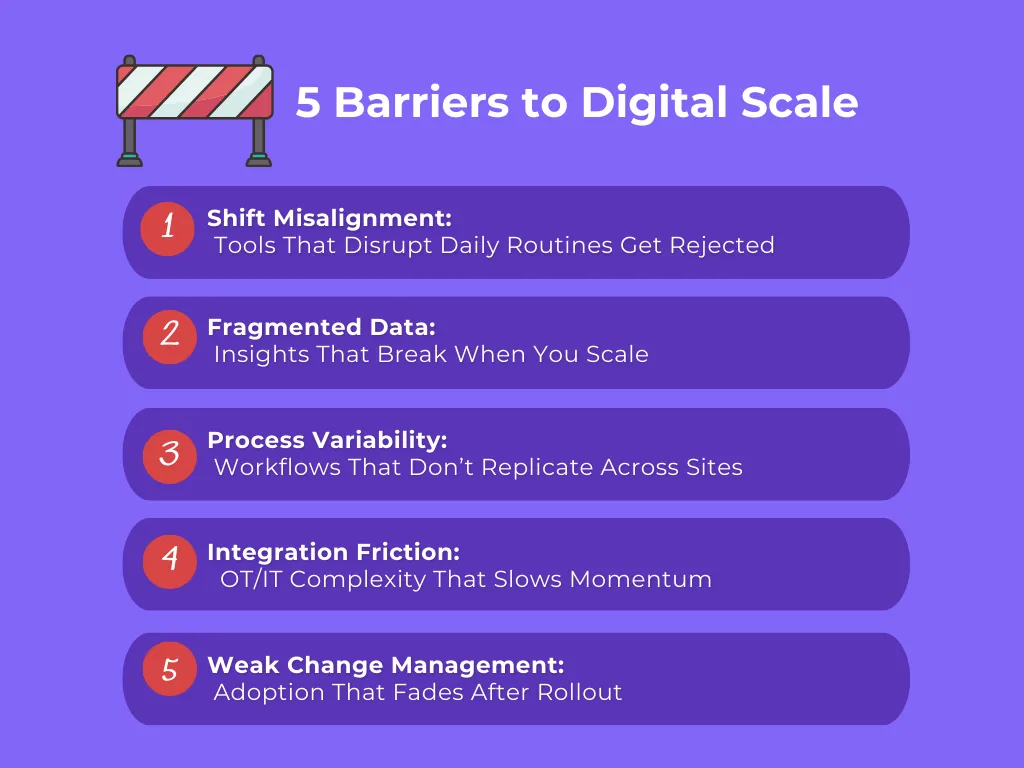 Image 1: From pilot purgatory to production: the five barriers asset-intensive operations must overcome to scale successfully.
Barrier #1: Shift Misalignment
Tools That Disrupt Daily Routines Get Rejected
What happens:
Pilots succeed with a small group of motivated users. Production requires adoption across hundreds of operators and supervisors who may not see immediate value.
An oil terminal piloted a digital shift handover tool with strong early usage. After rollout across all shifts and sites, adoption dropped to 40% within six weeks. The tool added steps and felt slower than paper.
Why asset-intensive operations are different:
In refineries, chemical plants, offshore platforms, and vessels, shift routines are tightly structured around safety, inspections, handovers, and operational priorities. Even small disruptions are quickly rejected.
What works:
Design with frontline workers from day one. Tools must reduce administrative burden and strengthen handover continuity, not add parallel reporting. At Nouryon’s chemical plants, operator engagement increased 4x compared to legacy systems because the platform was designed with operator input and eliminated manual logs and duplicate data entry rather than digitising them.
If scaling breaks shift continuity, adoption collapses.
Barrier #2: Fragmented Data
Insights That Break When You Scale
What happens:
Pilots rely on curated data. Scaling reveals fragmented reality: historians, ERP systems, maintenance software, spreadsheets, email threads, and paper logs all coexist.
Manual consolidation can sustain one site. Enterprise rollout requires automated integration across multiple assets. That’s when inconsistent tags, naming gaps, and incomplete histories surface.
Why asset-intensive operations are different:
Energy, chemical, and process industries generate high volumes of data across distributed assets. Legacy OT systems and decades of evolving practices create inconsistent data structures.
What works:
Do not attempt to “fix all the data first.” Instead, build a unified data layer capable of normalising and contextualising information in real time. Once data becomes structured and reusable across sites, analytics and AI shift from experimental to operational.
At Nobian, integrating data from seven chemical manufacturing sites enabled accurate, real-time visibility that prevented €980k/year in raw material losses.
Barrier #3: Processes Variability
Workflows That Don’t Replicate Across Sites
What happens:
A pilot works in a controlled environment. Expansion reveals that inspection routines, deviation logging, and shift handover protocols vary significantly between locations.
A chemicals company deployed a digital inspection workflow successfully at one plant. Rollout failed elsewhere because process definitions were fundamentally different.
Why asset-intensive operations are different:
Many asset-intensive organisations grow through mergers or operate facilities built under different regulatory and operational eras. Local habits become embedded practice.
What works:
Define which processes must be standardised globally, such as shift handovers, deviation management, and safety workflows, and where controlled flexibility is allowed. Scaling is not cloning. It is structured replication with governed adaptability.
At a leading chemical manufacturer, this approach reduced manual errors, streamlined routines, and generated €150,000 in annual savings.
Barrier #4: Integration Friction
OT/IT Complexity That Slows Momentum
What happens:
Pilots operate with limited integrations or manual bridges. Scaling requires secure, automated connectivity with historians, SCADA, DCS, ERP, and cloud systems. Cybersecurity reviews extend timelines. Integration projects stretch into months, on average 12-18 months in asset-intensive operations. Momentum fades. Integration friction kills more scaling initiatives than technology failure.
Why asset-intensive operations are different:
Legacy OT systems were not designed for interoperability. In safety-critical operations, experimentation is constrained. Every connection must be secure and validated.
What works:
Use platforms with pre-built industrial connectors and clear IT/OT governance. Integration must be designed early, not postponed until rollout. Equally important, workflows must remain adaptable after integration. If every refinement requires IT intervention, improvement cycles slow and local ownership erodes.
At Nobian’s chemical plants, integration across seven sites in three countries avoided the typical 12–18 month delay because scalability was engineered from the start.
Barrier #5: Weak Change Management
Adoption That Fades After Rollout
What happens:
Pilots rely on informal training and voluntary participation. Production requires structured onboarding local champions, reinforcement across shifts, and sustained leadership visibility. Without reinforcement, reversion to paper and spreadsheets often occurs within months.
Why asset-intensive operations are different:
24/7 shift operations can’t pause for training. Crews rotate. New hires join continuously. Support must function across geographies and time zones.
What works:
Treat change management as an operational workstream, not a launch event. Provide shift-specific onboarding. Embed local champions. Reinforce adoption through daily routines. Maintain leadership visibility beyond deployment.
At Stolt Tankers, this approach enabled the scaling of continuous improvement practices across 104 chemical tankers. Integration, crew involvement in design, and sustained support were built into the pilot phase. Adoption remained high because the platform enhanced existing routines rather than disrupting them.
What This Means
If your pilots delivered results but never scaled, you’re not alone. These barriers are predictable and manageable when identified early.
Instead of asking whether digitalisation works, ask whether scaling was designed from the start:
-
Are tools built around shift reality?
-
Is data structured for reuse across sites?
-
Are core processes consistent enough to deploy?
-
Is change management ongoing?
-
Is OT integration planned early?
These are not reasons to slow down digitalisation. They are the conditions that enable sustainable scaling.
Key Takeaways
-
70% of manufacturers remain stuck in pilot purgatory due to organisational barriers, not technology failure.
-
Shift misalignment occurs when tools add friction to 24/7 operational routines rather than reducing burden.
-
Fragmented data across sites breaks insights that worked in single-location pilots.
-
Process variability and integration delays (averaging 12-18 months) prevent consistent deployment.
-
Weak change management, treating adoption as a launch event rather than ongoing practice, causes reversion within months.
The Real Cost of Staying in Pilot
Pilots feel controlled. They demonstrate potential without forcing organisational change. But staying in pilot carries cumulative cost.
Every month at pilot stage means:
-
Manual reporting continues
-
Known deviations repeat
-
Operational context is lost in handovers
-
Improvement cycles move slowly
The technology may be proven but the inefficiencies remain.
Progress doesn’t stall because pilots fail. It stalls because continuity between pilot and production was never designed.
Ready to Move Beyond Pilot Purgatory?
Start by understanding where you stand today. A structured digital maturity assessment can identify which barriers are limiting scale and what to prioritise first.
Or see how Cyzag supports refineries, terminals, chemical plants and maritime operators in overcoming these barriers without the typical 12-18 month integration delays.
FAQ: Scaling Digital Pilots in Asset-Intensive Operations
The following questions address common concerns about scaling in asset-intensive operational environments.
How long does it take to scale a digital pilot in asset-intensive industries?
Timelines depend on integration complexity, process alignment, and change readiness. Single-site scaling may take weeks; multi-site deployment can take months. Organisations that design governance, integration, and adoption during the pilot phase move significantly faster.
Q. Why is scaling harder in energy and asset-intensive operations?
Scaling is harder because these industries operate in 24/7, safety-critical environments with legacy OT systems and distributed assets. Integration must be secure. Downtime is unacceptable. Workflows are embedded in shift routines. These constraints increase complexity but also increase the value of successful scaling.
Q. What is the most common reason digital pilots fail to scale?
Digital pilots fail to scale when scaling is treated as a technical rollout rather than an operational transformation. Technology may be validated during the pilot. But when integration, process alignment, and change management are postponed, organisational friction appears during deployment and adoption declines.
Do processes need to be standardised before scaling?
Core processes must be standardised before or during scaling. Shift handovers, deviation management, and safety workflows require baseline consistency across sites. Standardisation does not mean rigidity. Effective scaling balances aligned core workflows with controlled local flexibility.
How does adaptability affect long-term digital adoption?
Long-term adoption depends on adaptability. Operational environments evolve. If workflow changes require IT intervention or custom coding, improvements slow down and engagement drops. Platforms that allow governed, no-code configuration enable teams to adjust processes continuously while maintaining control.
Where does AI fit into pilot-to-scale initiatives?
AI becomes effective after data is unified and workflows are structured. Without reliable data and consistent processes, AI remains experimental. When the foundation is in place, AI-driven analytics can support earlier deviation detection, predictive optimisation, and faster operational decisions at scale.
Follow Cyzag on LinkedIn for new articles and stories.