What Shift Handover Can’t Do Alone. And What It’s Being Asked to Carry
Shift handover problems in manufacturing rarely start at the handover. Learn the continuity breaks causing the same issues to resurface every shift.
11 min read
Shift handover problems in manufacturing and 24×7 operations rarely start at the handover itself. The pressure to transfer everything that matters in minutes at the end of a long shift is real. And most teams work hard to get it right. Yet the same problems keep surfacing on the next shift, the next week, the next month. This article argues that the real issue is rarely the handover itself. It is everything the handover is being asked to carry: context that was never captured, history that lives in no system, and decisions that didn’t survive the shift that made them.
Why Shift Handover Problems Keep Getting the Blame
Ask almost any operations manager what causes continuity problems in their plant and the answer comes quickly: shift handover. The incoming crew didn’t get the full picture. The outgoing team ran out of time. The logbook entry was too brief. The verbal briefing missed a detail that mattered.
This is understandable. Shift handover is the most visible seam in a 24×7 operation. It happens multiple times a day, involves every crew, and is the moment where whatever was known, or wasn’t, becomes immediately consequential.
The attention is not misplaced. The UK Health and Safety Executive has documented that communication failures at shift handover have been a contributing factor in some of the most serious industrial incidents on record, including Piper Alpha in 1988, where the failure to pass on critical information between shifts contributed to a disaster that cost 167 lives. When the stakes are that visible, handover becomes the natural focus for improvement efforts.
But blaming shift handover for continuity failures is like blaming the junction at the end of a leaking pipe. The junction is where the water appears. It is not where the leak begins.
Focusing on handover makes sense; it is the most visible moment, and improving it does help. The problem is that it cannot fix what it didn’t cause.
Most of the context that handovers fail to transfer was never captured in the first place.
Where Continuity Actually Breaks
To understand why handover improvement has a ceiling, it helps to look at what happens at three distinct points: during the shift itself, at the transition, and in what the incoming crew can access after.
Break #1: Context Is Lost During the Shift
During every shift, operators make dozens of decisions that carry operational significance. A vibration was noticed on a pump; deemed acceptable for now, but worth watching. The temperature was running slightly high, but was compensated for by adjusting the flow. A deviation was observed and logged, but the reasoning behind the workaround stayed in the operator’s head.
None of this is negligence. It reflects the pace of operational work. Decisions accumulate in real time, often faster than they can be documented. By the time the shift ends, the outgoing crew is working from memory to reconstruct a story that was never fully written down.
Handover is then asked to carry context that the shift itself never preserved.
Break #2: The Incoming Crew Has No Structural Memory to Draw On
When the incoming crew starts their shift, they receive a briefing; verbal, written, digital, or some combination. What they rarely receive is structured access to what was known before: the prior decision on that same pump, the history of that deviation, the context behind the current workaround.
Most operational systems are designed to record events. They capture readings, task completions, and exception logs. What they do not systematically preserve is the reasoning, the intent, and the accumulated judgement behind those events.
So the incoming crew starts each shift with incomplete context, not because the outgoing crew failed to communicate, but because no system was keeping the memory that communication would need to draw on.
Break #3: What Happens After Handover Is Rarely Connected Back
Continuity doesn’t only break at the transition between shifts. It also breaks downstream: when maintenance receives an issue without the operational context that prompted it, when an inspection finding sits in a system unconnected to the prior three times the same condition was observed, or when an improvement action is closed without ever reaching the people executing daily work.
Each of these downstream breaks cycles back into handover as invisible load. The incoming crew is briefed on what happened. They are rarely briefed on what it means in light of everything that preceded it.
“We keep fixing handovers instead of fixing what handovers are forced to compensate for.”
Why Handover Improvement Efforts Fall Short
Organisations consistently invest in handover improvement. They introduce structured handover templates, shift briefing protocols, digital logbooks, and handover checklists. These improvements are not wrong. They often produce genuine short-term gains and are needed.
But they tend to plateau. Within months, the structured template starts being filled in quickly to meet the form rather than the purpose. A logbook that is designed only to record events, rather than preserve the reasoning and decisions behind them, captures more data without building more memory. The checklist confirms completion without preserving intent.
The reason is structural. Handover improvement efforts focus solely on the transition, treating it as a communication problem. But the transition is a symptom. What needs to change is how operational context is captured during the shift, stored across time, and made available to the incoming crew as a starting point, not just as a summary of the last few hours.
When handover carries the full burden of continuity, it will always fail, not because of poor execution, but because the task is structurally impossible.
What This Looks Like in Practice
Consider a recurring scenario that operations leaders across process manufacturing, energy, and terminal environments will recognise.
An asset has been running with a known anomaly that is not critical enough to shut down, but significant enough that operators have been monitoring it closely. Over the past two weeks, four shifts have observed the same condition, each time making a reasonable judgment call to continue. Two work orders have been raised and deprioritised. One inspection finding sits in a maintenance queue.
None of this is connected in any system the incoming crew can see during handover. The outgoing supervisor mentions the asset verbally. The incoming supervisor nods. On the third shift after that handover, the condition escalates.
The investigation asks: what did the handover miss? But the more precise question is: why wasn’t the accumulated history of that asset visible to anyone handing over?
The handover didn’t fail. The system around it did.
The Role of Handover in a Continuity-First Operation
This is not an argument for doing less at handover. Handover matters. It is a critical operational ritual, and the quality of the briefing, its clarity, its completeness, and its focus on what actually needs attention make a real difference.
But handover works best when it is supported by continuity, not burdened with compensating for its absence.
In operations where continuity is well-maintained, handover becomes a structured moment of alignment rather than a desperate transfer of everything that might matter. The incoming crew arrives with access to prior decisions, asset history, and the operational context that makes the briefing meaningful. The outgoing crew doesn’t need to reconstruct the story; they are handing over a current chapter in a narrative that both sides can already read.
That shift, from handover as a last resort to handover as a structured alignment, is where operational continuity starts to hold.
What the Right Tools Actually Do
This is also where the design of digital tools becomes consequential. A digital shift logbook is not inherently a continuity tool; what it does depends entirely on what it is built to capture and connect. A logbook designed only to replace paper does one thing better: it records events in a cleaner format. A logbook designed for continuity does something different; it preserves the reasoning behind events, surfaces patterns across shifts, and gives the incoming crew a structured starting point rather than a blank slate.
The same distinction applies to handover tools and routine management systems. When these are designed to connect what happened to why it happened and to make that connection visible to the next crew, they stop being record-keeping tools and start being continuity infrastructure.
The question to ask of any operational tool is not: does it capture the shift? It is: does it carry operational context forward?
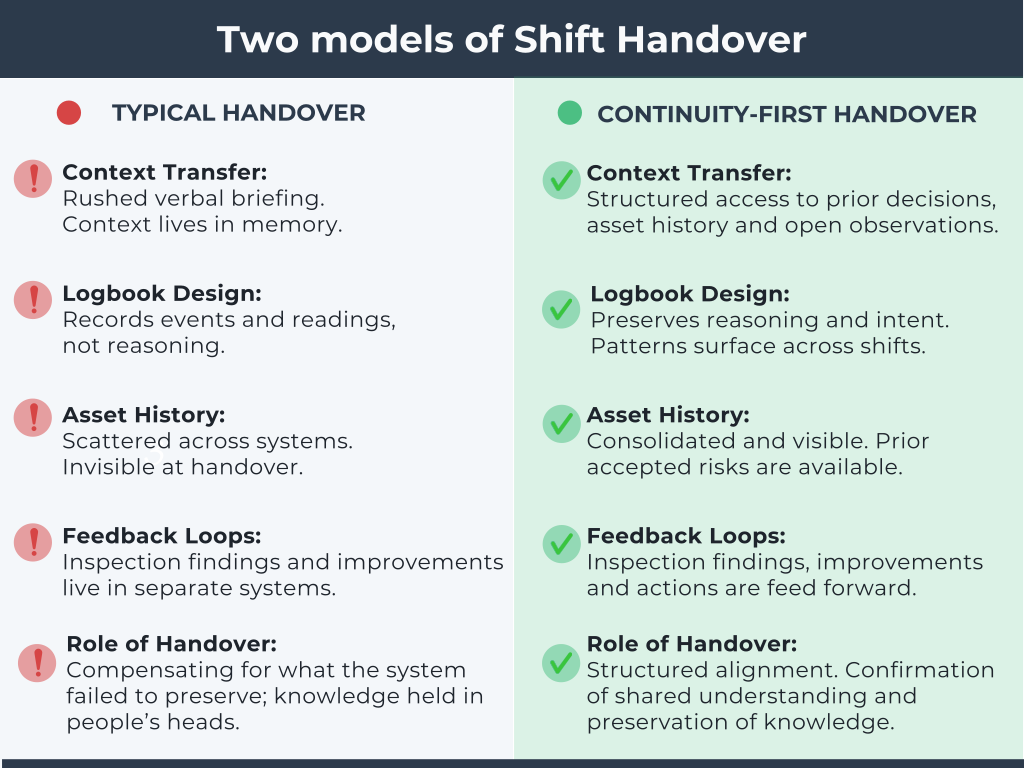 Image 1: Two models of shift handover: in a typical operation, handover compensates for what the system failed to preserve. In a continuity-first operation, handover becomes a structured moment of alignment built on context that was already captured.
How Organisations Can Start Closing the Gap
Recognising that the handover is a symptom rather than the source is the starting point. What follows is a different kind of improvement question: not ‘how do we make the handover better?’ but ‘what needs to be in place so the handover has something to work with?’
The first place to look is during the shift itself. Are operators capturing not just what happened, but why decisions were made? A deviation logged without its reasoning leaves the next crew with a data point and no context. The goal is not more documentation; it is smarter capture of the judgements that actually shape how operations run.
The second is how that context is stored and connected. Asset history, prior inspection findings, open actions, and accepted risks need to be visible in one place and easily retrievable, not scattered across maintenance systems, logbooks, and verbal memory. This is also where newer capabilities in operational platforms are beginning to change what’s possible: when structured context exists, tools that allow operators to query that history conversationally, such as AI chatbots, can surface what would otherwise take minutes of manual searching. The value isn’t the technology itself, but the accessibility of the accumulated context that handover depends on. When the incoming crew can see the operational narrative, not just the latest entry, handover becomes a confirmation of shared understanding rather than a race to transfer everything before the clock runs out.
The third is feedback. Do improvements made in one shift reach the next? Do inspection findings shape how rounds are conducted the following week? Does a closed action actually change anything about how daily work is done? When these loops close, continuity compounds. When they remain open, every shift starts from a slightly depleted version of what was already known.
Three Questions to Diagnose Where Continuity Breaks in Your Operation
If shift handover continues to underperform despite repeated improvement efforts, the answer is rarely in the handover itself. A more useful starting point is to ask:
-
During the shift: Are operators capturing decisions and reasoning, not just events and readings, in a way that survives the shift change?
-
At handover: Does the incoming crew have structured access to prior decisions about the same assets and conditions or only to what the outgoing crew can recall in the moment?
-
Downstream: Do inspection findings, maintenance actions, and improvement outcomes feed back into how the next shift operates or do they live in separate systems that operators cannot see during handover?
If the answer to most of these is “no” or “not reliably,” the handover process itself is not the issue. The continuity structure that handover depends on is missing.
Final Thought
Shift handover is not broken. It is overloaded.
It has been asked to carry the full weight of operational continuity in environments where continuity was never systematically built. Every improvement effort that targets handover in isolation will hit the same ceiling because the problem is not the transition; it is the absence of a structure that keeps operational context alive across shifts, inspections, improvement cycles, and time.
When teams recognise this, the questions they ask change. They stop asking how to make handover faster or more structured. They start asking how to ensure that what was already known doesn’t have to be rediscovered.
That is a different problem. And it has a different solution.
If you’d like to explore how to strengthen operational continuity in your organisation, starting with the design of your shift handover and logbook tools, our team is available for an exploratory conversation. Reach us at
Ready to Strengthen Operational Continuity?
If you’d like to explore how to strengthen operational continuity in your organisation, starting with how your shift handover and logbook tools are designed, our team is available for an exploratory conversation.
FAQ: Shift Handover and Operational Continuity
The following questions address common concerns about shift handover and continuity in asset-intensive operational environments.
Why does shift handover keep failing even after we improve it?
Because most handover failures originate before and after the transition itself. If the context that needs to be transferred was never captured during the shift, no handover process can reconstruct it reliably. Improving the handover moment without addressing how operational context is captured and stored will always produce short-term gains followed by plateau.
What is the difference between a handover problem and a continuity problem?
A handover problem is about the quality of the transition between crews: the briefing, the format, and the completeness of the transfer. A continuity problem is about whether operational context (decisions, asset history, prior observations, improvement outcomes) survives across shifts, teams, and systems over time. Most organisations have a continuity problem and mistake it for a handover problem.
Is this relevant to single-site operations, or mainly for multi-site environments?
Both. Continuity breaks occur within a single plant just as they do across multiple sites. The number of shifts running in parallel, the volume of assets under management, and the pace of operational decision-making all amplify the problem, regardless of how many sites are involved.
Does digitalising shift handover solve the continuity problem?
Digitalising handover can significantly improve the quality and structure of the transition, and it is a meaningful step forward from paper-based processes. But the value of a digital tool depends on what it is designed to preserve. A digital logbook that captures events and readings provides better access and auditability. A digital logbook that also preserves decision context, surfaces patterns across shifts, and connects to inspection and improvement workflows goes further: it becomes part of the continuity structure itself, not just a better record. The distinction matters. The goal is not to replace paper, but to build memory that survives the handover.
How do we know if we have a continuity problem rather than a handover problem?
Three indicators are usually reliable. First, the same conditions and deviations recur across different shifts and are treated as new each time. Second, experienced operators carry disproportionate amounts of operational context in their heads,and their absence creates immediate visibility gaps. Third, improvement actions are completed, but daily work looks and feels the same. If these patterns are familiar, the issue is continuity, not communication.
Further reading: Shift Handover — The Basics You Need to Know | Shift Logbook: How to Create an Efficient One | How to Make Continuous Improvement Truly Continuous
Follow Cyzag on LinkedIn for new articles and stories.