How to Start with Process Improvement: Processes
Our 3-part series dives into the essentials for enhancing manufacturing efficiency in the process industry. Here we focus on Processes.
Updated 3 November 2025 11 min read
As the industry progresses, it brings forth new manufacturing costs, efficiency, and sustainability challenges. However, many businesses still grapple with significant inefficiencies. Untidy processes and manual tasks consume valuable time for your team, diverting their attention from essential priorities. These accumulated costs waste vital resources necessary for maintaining competitiveness.
Process engineers, plant engineers, and continuous improvement professionals are responsible for addressing these issues within the process industry. If you work in one of these roles and aim to tackle these needs effectively, you require a solid understanding of the fundamentals of process improvement.
In this second part of our three-part series exploring People, Processes, and Tools, we concentrate on understanding the role of establishing Processes to drive performance in your manufacturing plant.
 *Image 1. The three aspects of manufacturing efficiency are People, Processes, and Tools. *
Processes: Streamlining Operations for Optimal Efficiency
Efficient work processes are the cornerstone of a successful manufacturing plant and constitute the second crucial aspect of process improvement.
Over the past 50 years, manufacturers globally have implemented various programs and techniques to cut costs and enhance product quality and customer service. Approaches like Lean, Six Sigma, TPM, TQM, and full production systems have proven effective, with companies like Toyota, Procter & Gamble, and Danaher boosting productivity by 6% or more annually, according to Bain & Company.
However, improving work processes is a continuous effort and revisiting practices and reevaluating new possibilities is crucial to staying competitive, as is the emergence of transformative digital and Industry 4.0 technologies. These advancements can elevate productivity by over 10% while offering additional benefits such as flexibility, quality improvement, resource efficiency, and labour savings, as indicated by Bain & Company.
Your team can use various process improvement methodologies to remove inefficiencies and increase performance, integrating them to run a smooth operation. The choice of methods typically hinges on the specific objectives for enhancing processes and the areas targeted for improvement. Let’s explore the specifics of some key ones below.
Lean Manufacturing
The lean philosophy, originating from the Toyota Production System (TPS) in the late 1940s, has profoundly influenced the process industry by emphasising efficiency, quality, and customer satisfaction and cultivating a culture of continuous improvement.
Lean manufacturing is a proven strategy that uses techniques and tools to reduce waste and increase quality. As Bain & Company pointed out, companies that adopt lean production measures can typically reduce production costs by 5% to 15%.
The foundation of lean, coming from the TPS, has two pillars: continuous improvement and respect for people. These principles are the basic foundation of lean manufacturing, and all the techniques and tools are related to them. The core purpose of this operating model is the just-in-time (JIT) production that can be achieved by removing all wasteful activities.
However, the term “lean” emerged only in 1988, when John Krafcik established it. In 1996, James Womack and Daniel Jones defined the five lean principles.
The Five Lean Principles
Lean principles are identifying value from the customer’s perspective, mapping the value stream to spot and reduce waste, creating an uninterrupted flow to serve customers better, establishing a pull system that responds to customer needs, and pursuing perfection through continuous improvement.
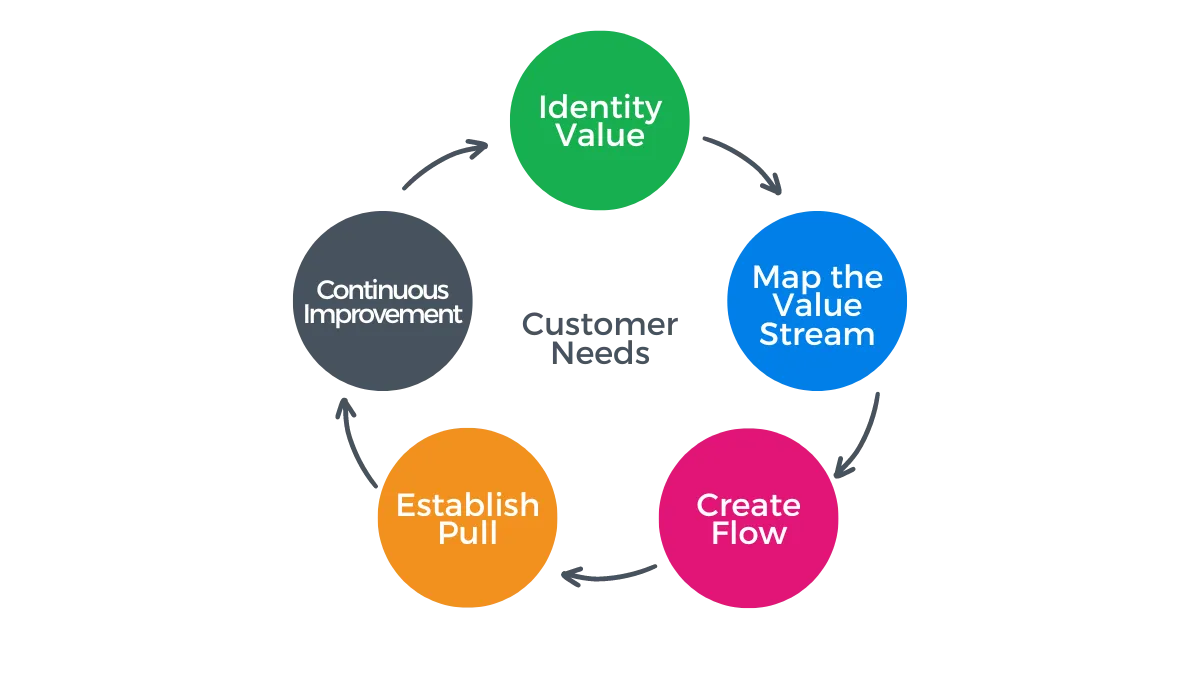 Image 2. The five lean principles
The lean methodology aims to deliver value to the customer by eliminating waste. The definition of waste is anything that does not add value from the customer’s perspective; in other words, it is everything customers are not willing to pay for.
The Eight Wastes of Lean
Initially, Taiichi Ohno pinpointed seven forms of waste within the Toyota Production System. However, as lean principles expanded globally and across various sectors, an additional type of waste was recognised: the underutilisation of talent. To aid in recalling these wastes, Jean Cunningham, among others, introduced the acronym “DOWNTIME”.
-
Defects: product failing to meet customer specifications.
-
Over-production: producing too much, too soon.
-
Waiting: increasing production cycle time without adding value.
-
Neglect of human talent (non-utilised talent)
-
Transportation: movement of materials without adding value.
-
Inventory: the extra production required to accommodate process fluctuations.
-
Movement: movement of operators without adding value.
-
Excess processing (Over/ extra processing): Excessively processing materials beyond customer requirements.
These different kinds of waste can be transformed into opportunities for improvement. To make this happen, it is vital to enable and empower people, developing workforce skills such as “waste eyes” through well-established improvement routines and problem-solving abilities.
Lean Tools
Lean manufacturing incorporates various tools and methods to help you achieve your objectives. The tools best suited to your business can vary based on your specific environment. Effective and broadly utilised lean manufacturing tools for the process industry are the 5S method, A3, Kaizen (Continuous Improvement), Plan-Do-Check-Act (PDCA), Kanban, and Value Stream Mapping. The details of these and other lean tools will be explored in our next article focused on tools. They are critical to streamlining production, minimising waste, and improving quality and efficiency.
Six Sigma
Developed in the mid-1980s, Six Sigma’s core objective is to improve by identifying and removing the causes of defects and reducing all sources of variation in the processes. In simple terms, Six Sigma quality performance means 3.4 defects per million opportunities. This approach is not just a set of tools but a philosophy that strongly emphasises decision-making based on data and empirical evidence, enhancing quality, efficiency, and reliability in the process industry.
 Image 3. Six Sigma Curve
The financial benefits of Six Sigma are extensive and well-documented. Research conducted by iSixSigma examined the hard statistics recorded by Motorola, Allied Signal, GE, and Honeywell and discovered that these companies experienced a year-on-year increase in savings and revenue growth, amounting to billions of dollars.
The Core Principles of Six Sigma
At the heart of the Six Sigma methodology is the perspective that all processes can be defined, measured, analysed, improved, and controlled (DMAIC). These principles guide businesses in identifying areas for improvement, understanding the nature and root causes of defects, implementing solutions, and establishing controls to sustain those improvements over time.
In the process industry, this structured approach helps address complex processes that involve numerous variables and potential points of failure, enhancing product quality, improving yield, reducing downtime, and optimising resource utilisation.
Six Sigma Statistical Tools and Techniques
Six Sigma distinguishes itself through its rigorous use of statistical tools and techniques. These tools enable businesses to move beyond assumptions and subjective judgment, providing a quantitative foundation for decision-making. Tools such as statistical process control (SPC), control charts, root cause analysis (RCA), failure mode and effects analysis (FMEA) and process mapping are particularly effective in the process industry. Our next blog, focused on process improvement tools, will explore more details regarding Six Sigma tools.
Lean Six Sigma
Six Sigma and Lean methodologies have increasingly become integrated in their approach to process improvement, leading to the widespread adoption of Lean Six Sigma. While Six Sigma concentrates on minimising process variation and enhancing control over processes, Lean aims to eliminate waste—activities that don’t add value—and fosters the standardisation of work and fluidity of operations. The convergence of these two methodologies into Lean Six Sigma reflects a holistic approach to process improvement, combining the strengths of both to achieve superior outcomes.
Lean Six Sigma is grounded in a data-driven, fact-based philosophy that prioritises preventing defects over merely detecting them. It aims to boost customer satisfaction and improve financial performance by reducing inconsistencies, waste, and process times. Moreover, it advocates for standardised work practices and smooth workflow, contributing to a business’s competitive edge.
This methodology is applicable in any setting where there are opportunities to reduce variation and waste. It emphasises the importance of engaging all employees in process improvement efforts and is very much used in the process industry. Successful implementations often begin with the lean approach, making the workplace as efficient and effective as possible, reducing waste, and using value stream maps to improve understanding and throughput. If process problems remain, more technical Six Sigma statistical tools may then be applied.
Total Productive Maintenance (TPM)
Total Productive Maintenance (TPM) is an approach developed in Japan in the 1970s, designed to maximise equipment effectiveness and minimise production losses due to equipment failure. TPM extends beyond traditional maintenance to involve every level of an organisation, from top management to floor operators, in preventive and predictive maintenance activities. It blurs the traditional boundaries between the roles of production and maintenance by placing a strong emphasis on empowering operators to help maintain their equipment.
The goal of TPM is to achieve perfect production with no breakdowns, slow runs, or defects, effectively bringing the incidence of failures to zero. It also focuses on empowering workers to help maintain their equipment, fostering a sense of ownership and collaboration across the organisation.
The benefits of implementing TPM are significant, including increased machine availability, improved performance efficiency, and higher quality output, all of which contribute to the bottom line. Companies adopting TPM can expect to see a reduction in machine downtime, lower maintenance costs, and improved productivity.
The TPM Pillars and Tools
The traditional approach to TPM consists of 5S as a foundation and eight supporting activities, usually called pillars.
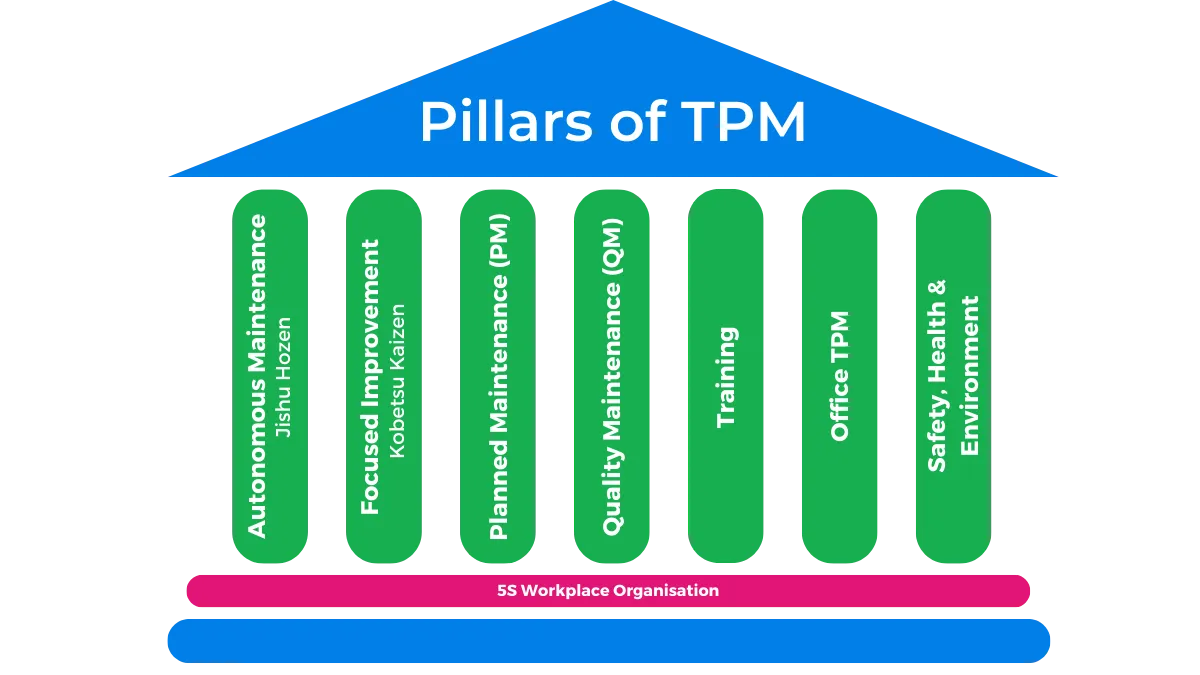 Image 4. The eight pillars of TPM
The goal of 5S is to create a clean and organised work environment, which will allow equipment to operate efficiently. The eight pillars of TPM are primarily focused on proactive and preventative techniques for improving equipment reliability.
These pillars support a holistic approach to preventive maintenance and continuous improvement, aiming to achieve zero breakdowns, defects, and accidents in the manufacturing process. By integrating these pillars into their operational framework, organisations can significantly enhance their productivity, product quality, and worker safety.
Seiichi Nakajima, the Father of TPM, was instrumental in developing the Overall Equipment Effectiveness (OEE) metric. Nakajima introduced OEE to the world through his early 1980s publication with the Japan Institute of Plant Maintenance. Discontent with existing efficiency measurement models, Nakajima sought to devise OEE as a more robust and reliable measure. It reflects actual equipment effectiveness accurately.
Total Quality Management (TQM)
Total Quality Management (TQM) is a structured approach to organisational management. It seeks to improve the quality of products and services. This is achieved through continually analysing its production processes to reduce or eliminate errors in manufacturing.
Implementing TQM results in numerous benefits, including improved quality of products and services, higher customer satisfaction, increased efficiency in processes, and reduced costs.
TQM focuses on long-term success through customer satisfaction and benefits from the involvement of all organisational members in improving processes, products, services, and the culture in which they work.
TQM Principles
The core principles of TQM involve customer-focused management, where customer satisfaction is the top priority, and continuous improvement, a steady, ongoing effort to improve products, services, or processes that require an integrated effort among all employees.
TQM also emphasises process-oriented thinking, a shift from managing results to managing processes to achieve those results. Moreover, TQM insists on quality management being a total organisational effort, where the strategy involves integrating quality disciplines into all aspects of the organisation.
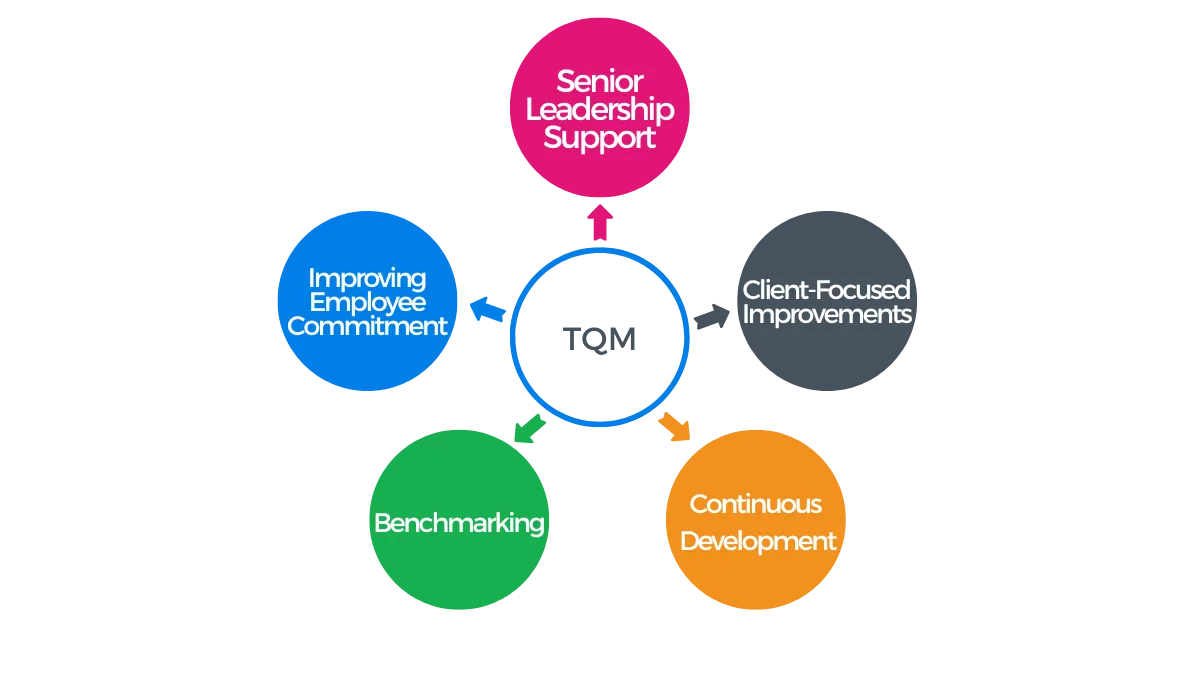 Image 5. TQM Principles
This approach fosters a culture of continuous improvement, where employees are encouraged to innovate and improve their work environment continuously. TQM’s emphasis on company-wide participation helps create an environment where quality becomes everyone’s responsibility. This means it’s not just the responsibility of the quality control department.
Agile Manufacturing
Agile Manufacturing represents a modern methodology that enables companies to remain competitive and responsive in a rapidly changing market. This approach prioritises adaptability, flexibility, and swift reactions to customer and market demands.
As a concept, agile manufacturing merges lean practices with software development agility. There isn’t a universally adopted, singular framework akin to what exists in agile software development (e.g., Scrum or Kanban). Nevertheless, agile manufacturing principles guide organisations towards more responsive, adaptable, and customer-focused production systems.
This methodology is still evolving, with companies often tailoring agile practices to fit their unique operational needs and industry challenges. Companies adopt agile manufacturing through frameworks aligned with goals, using tech, teamwork, and improvement for agility.
The principles that appear in different approaches are responsiveness to customer needs, leveraging advanced technologies to improve product development and production processes, and fostering a culture of continuous improvement and innovation.
This approach emphasises the importance of collaborative work environments, where cross-functional teams work closely to streamline processes and enhance product quality. Agile manufacturing requires a commitment to flexibility in thought and action from all levels of an organisation. It demands a workforce skilled in multiple disciplines and comfortable with change, supported by technology that facilitates rapid product development and iteration.
Technology and Automation
Technology and automation can be considered processes and tools within the broader context of organisational improvement. They are enablers for enhancing efficiency, quality, and productivity within the process industry.
According to a McKinsey study, one-third of the tasks required by employees in 60% of jobs could be automated. Automation is an integral component of a strategic approach to removing waste, modernising operations, streamlining workflows, and driving operational excellence.
Incorporating technology and automation as part of process improvement offers a pathway to transforming traditional operations into more efficient, reliable, and scalable systems. These elements are the backbone of digital transformation strategies and Industry 4.0. They empower organisations to leapfrog traditional constraints and unlock new performance and customer satisfaction levels.
From process control systems to digitalisation, the Internet of Things (IoT), artificial intelligence (AI), and machine learning, digital technologies can enable data-driven decisions, optimise operations, improve quality control, and reduce manual intervention.
Conclusion
Professionals in the chemical and process industry must grasp process improvement basics to boost operational efficiency and sustainable growth.
Embracing Lean, TPM, TQM, Six Sigma, and Agile manufacturing within a production management system yields synergistic advantages. Instead of seeking a single best methodology, combining various techniques into a unified strategy enhances organisational operations.
Integrating these processes with technology and automation fosters sustainability and optimises processes and efficiency. However, to be effective, digital technologies should be incorporated into the existing manufacturing environments and not just attached to them, promoting a comprehensive digital integration that complements existing methodologies.
In our next article, we will discuss the importance of Tools for improvement in the process industry. This will complete the trilogy People, Processes and Tools.
Read part one: How to Start with Process Improvement: People Read part three: How to Start with Process Improvement: Tools.
Follow Cyzag on LinkedIn for new articles and stories.