Digitalisation in Action: The DILO Three Operations Managers
Explore the routines of three operations managers and discover how digitalisation in operations can significantly impact efficiency.
Updated 14 September 2025 12 min read
Digitalisation offers a promising path to improved industry efficiency, safety, and sustainability. However, no two plants are alike, each facing its unique challenges. Today, we’ll explore the daily routines of three operations managers: Tony, Oliver, and Lisa. Tony and Oliver are both eager to embrace digitalisation in their respective plants, while Lisa has already successfully implemented digitalisation. Despite sharing the same goal, Tony and Oliver encounter different challenges and opportunities in their daily work. In contrast, Lisa’s well-defined and efficient routines allow her to focus on identifying opportunities for further improvement. Let’s check the impact of digitalisation in operations.
Tony: The Struggle with Undefined Workflows
7:30 AM: A Rushed Start and Trying to Catch Up
Tony arrives at the plant to find the night shift handover struggling with communication, leading to confusion over priorities and missing crucial details. Without standardised processes, aligning the team’s efforts is difficult. Despite everyone’s hard work, the day starts disorganised. Tony spends his morning running between departments, trying to address overlooked issues and figure out what needs urgent attention. He feels he’s constantly putting out fires rather than focusing on strategic improvements.
10:00 AM: Gemba Walk—Seeking Clarity Amid Confusion
Tony prioritises being on the shop floor despite having many tasks. During his Gemba walk, he sees firsthand the impact of chaotic communication and poor routine management. His team is working hard, but without clear processes, information becomes siloed, causing uncertainty about the next steps. Tony notices the frustration on their faces—they are tired of working extra hours without seeing meaningful results. He realises that the lack of structured workflows and effective communication tools is a significant barrier to progress. He also notices that several pieces of equipment have been out of service longer than expected due to poor coordination between the maintenance and production teams. Improving maintenance scheduling and tracking could prevent downtime and improve productivity.

10:30 AM: Struggling with Manufacturing Costs and Performance
Tony focuses on managing manufacturing costs and process performance, but inconsistent data reporting makes this problematic. Without reliable data, he finds it nearly impossible to make informed decisions. He consults the process engineer, who keeps detailed notes on process health. They discuss key issues, and Tony meets with the production and maintenance managers to agree on actions for improvement. Hunting for accurate data frustrates Tony, highlighting the need for a more efficient system. By the end, Tony realises that inconsistent record-keeping complicates tracking maintenance costs. This makes it hard to identify trends and control expenses. The maintenance manager disagrees with Tony’s assessment, and they leave the meeting without a consensus.
1:00 PM: Feeling the Frustration
By lunchtime, Tony feels exhausted. Instant messages and phone calls repeatedly interrupt his lunch to clarify priorities. Despite the team’s dedication, untidy processes and manual tasks consume valuable time. These distractions divert their attention from essential priorities. Tony believes digitalisation could streamline their work, but he knows establishing processes is critical first. Overhauling processes feels daunting, but he’s committed to making it happen.
2:00 PM: The Burden of Reporting
Tony dreads preparing the weekly site report, which involves gathering multiple sources of HSEQ, production, maintenance and performance figures. He spends hours copying and pasting from various Excel sheets, searching through emails, and calling colleagues for updates. The number of data silos in the organisation overwhelms him. Without a centralised system, discrepancies arise, revealing issues that should have been caught earlier. Tony compiles everything into a PowerPoint presentation, aware that some data might already be outdated.
5:00 PM: Report Discussion (Working overtime)
Instead of wrapping up, Tony meets with team leaders to review the report, which took longer than expected to prepare. They discuss the report data, issues, and actions for improvement in preparation for tomorrow’s senior management meeting. During the discussion, they recognised several recurring problems, leaving the team feeling like they were going in circles.
6:00 PM: End-of-Day Reflection
After a long day of firefighting and trying to align his team and reach a consensus, Tony heads home feeling drained. He knows his team is capable of more and is determined to bring order to the chaos through robust routines and digitalisation.
Oliver: Optimising an Organised System with Digitalisation
7:30 AM: Daily Huddle Preparation
The day begins with preparing for the daily huddle. Each team member spends about 30 minutes gathering the latest information from paper reports, Excel files and emails. They also arrive early to update the performance board manually.
8:00 AM: Daily Huddle
During the daily huddle, the team reviews safety and key performance indicators (KPIs), aligning priorities for the day. Thanks to standardised routines and visual management, communication is clear. The team registers actions to address deviations on the physical whiteboard. Each member notes their tasks and deadlines. Oliver reviews the maintenance schedule to ensure critical equipment inspections are planned without disrupting operations.
8:30 AM: Gemba Walk—Observing Efficiency and Identifying Opportunities
During his Gemba walk, Oliver saw a dedicated and effective team. However, he notices they spend significant time on manual tasks like updating physical boards, entering data into spreadsheets, and gathering information. These tasks consume time that could be used for strategic improvements. Oliver also observes that unplanned maintenance has caused production interruptions. He believes better predictive maintenance could prevent these disruptions and improve efficiency. Additionally, he sees that two recent improvements haven’t been sustained. Poor change management likely allowed old habits to return, undermining previous gains. Oliver believes digitalisation could integrate processes better, ensuring lasting improvements.

10:00 AM: Managing Manufacturing Costs and Performance without Data Integration
Oliver meets with key team members to review manufacturing costs, such as raw material usage, energy consumption, waste management and maintenance costs. This task is essential for cost control, but the manual data collection and analysis make it time-consuming and reactive. Oliver sees an opportunity to improve this process with real-time data integration, enabling proactive decision-making and quicker responses to changes and boosting variable cost optimisation. He also notes that maintenance costs could be better controlled with integrated systems that track maintenance activities and their direct impact on production costs.
1:00 PM: Lunch and Future Vision
During lunch, Oliver reflects on how digitalisation can further enhance the plant’s efficiency. He imagines a future where data flows seamlessly, visual management is fully digital, and his team can transition from administrative tasks to continuous improvement. Optimistic about the potential of digital tools to amplify their impact, his thoughts are interrupted by a phone call. The managing director asks for the month’s variable costs, which he couldn’t find.
2:00 PM: The Burden of Reporting
Oliver spent the afternoon compiling reports and preparing presentations for senior management. This labour-intensive process consolidates data from multiple sources, such as paper reports, Excel spreadsheets, and emails. The task is tedious and time-consuming, often requiring Oliver to double-check and reconcile inconsistencies. While the reports are necessary for decision-making, they leave little room for Oliver to focus on value-added actions or strategic initiatives. He knows that automating these routine tasks would free his team to focus on driving meaningful improvements. They would spend less time managing details.
4:00 PM: Struggles with OEE and Trust in Data
Oliver attends a meeting to discuss Overall Equipment Effectiveness (OEE), where he encounters fragmented data with inconsistencies from various sources and manual entries. As a result, much of the discussion focuses on validating the numbers instead of interpreting them. The team spends considerable time debating data accuracy, leading to frustration and a lack of trust in the results. This constant need for verification leaves little time to focus on actionable improvements. He realises he has enough reasons to automate OEE with a reliable, centralised data system, so Oliver adds it to the improvement list. Confident that this change will deliver a strong ROI, he moves forward with the plan.
5:00 PM: End-of-Day Review
As the day concludes, Oliver feels accomplished but recognises the opportunity for greater efficiency. Adopting a platform for digital operations could streamline plant operations, improve efficiency, and enhance collaboration, automating routine tasks while integrating data systems. Oliver believes that with these improvements, his team could achieve more with less effort, allowing them to focus on strategic actions that will drive the plant forward.
Lisa: Maximising Efficiency in Operations with Digitalisation and Standardisation
7:30 AM: Seamless Start with Real-Time Data
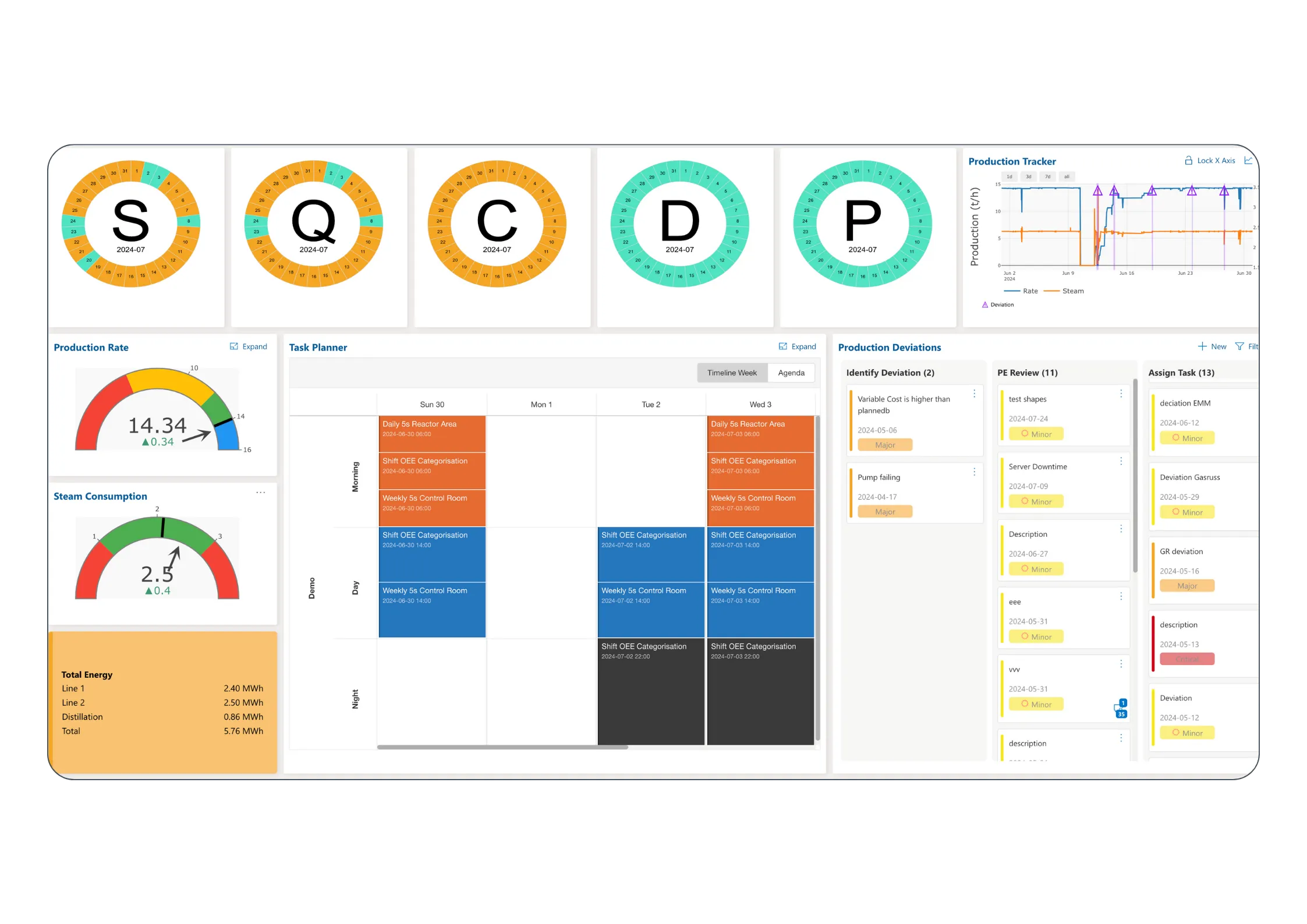
Lisa starts her day by reviewing the plant’s digital dashboard on the Cyzag platform, which provides real-time KPIs from overnight operations. Unlike manual reports, the platform allows her to spot deviations or issues quickly, offering an immediate, clear view of the plant’s performance. She notes a minor machine issue the team promptly resolved thanks to automated alerts and quick action. This seamless digital integration ensures that no problems are overlooked.
8:00 AM: Daily Huddle
During the daily huddle, Lisa and her team use a digital platform to review safety updates, KPIs, and maintenance schedules. Automated data collection and real-time updates appear instantly on the shared screen. This allows everyone to contribute and log actions directly into the system, with automatic reminders for follow-up. The team holds these huddles consistently, whether in person or remotely, ensuring the routine runs smoothly. This digital approach removes the need for manual whiteboards or note-taking, ensuring nothing is overlooked. Action points are assigned, and progress is tracked in real time, providing transparency and accessibility without manual check-ins.
8:30 AM: Gemba Walk: Empowering the Team for Continuous Improvement
During her Gemba walk, Lisa takes the time to genuinely listen to her team, encouraging them to identify and suggest opportunities for waste reduction. The team digitally records their improvement ideas using the PDCA (Plan-Do-Check-Act) method through tablets, mobile devices, or other digital systems. This approach makes it easy to document and track ideas and builds a sense of ownership among the team. Lisa actively involves the team in the improvement process. This ensures changes are implemented and sustained over time, fostering a culture of continuous improvement.

10:00 AM: Proactive Cost and Performance Management
Lisa reviews the plant’s cost structure, analysing energy consumption, material usage, and labour costs. With digital integration, data is up-to-date, making trends easy to identify. She spots a spike in energy usage on a specific machine, investigates it with data analytics, and identifies inefficiencies in the production schedule. Using integrated systems, Lisa’s team can proactively adjust to control costs and improve efficiency, moving away from reactive management.
1:00 PM: Strategic Planning and AI
During lunch, Lisa read a communication from the Cyzag team announcing AI integration into the platform. This update further enhances its capabilities. The plant already has a group of citizen developers—team members with deep operational knowledge—collaborating closely with the shop floor. Process engineers and CI experts use the Cyzag platform to quickly create, test, and scale digital solutions. With AI now embedded, Lisa sees more potential to capture the expertise of veteran staff. This ensures the retention of valuable knowledge despite an ageing workforce. The integration safeguards critical experience and empowers younger employees to innovate and lead. It shifts the team from routine tasks to more strategic, forward-thinking initiatives.
2:00 PM: Automated Reporting and Decision-Making
In the afternoon, Lisa reviews the plant’s performance reports, which are automatically generated by its digital platform. These reports, powered by real-time data, streamline decision-making and free Lisa from manual data collection. While reviewing, she calculates the digital tool’s return on investment (ROI) by comparing the plant’s performance improvements—such as reduced downtime and increased output—against the platform’s costs. The results confirm a strong ROI, with the performance gains significantly outweighing the initial investment.
3:00 PM: Presenting Reports and Aligning with Senior Management
Lisa presented the plant’s strong performance to senior management, highlighting the rapid problem resolution and standardised solutions made possible through the Cyzag platform. She emphasises how the development of citizen developers has played a crucial role in quickly achieving tangible results. By showcasing the calculated ROI, Lisa demonstrates that the investment in digitalisation has improved efficiency and delivered significant financial benefits. The discussion then shifts to future needs and the economic aspects of continuous improvement and sustainability initiatives, ensuring the plant’s ongoing progress.
4:00 PM: Optimising OEE
She joins a meeting to discuss Overall Equipment Effectiveness (OEE), reviewing the data directly from the digital platform. With accurate, real-time metrics, the team can focus on improving productivity rather than validating data, leading to more efficient operations.
5:00 PM: End-of-Day Reflection
Lisa concludes her day by checking the digital dashboard for outstanding issues or updates. She feels confident that the digital tools support her team, allowing them to focus on meaningful improvements rather than administrative tasks. Digitalisation has streamlined operations and empowered her team to perform at their best. Lisa reflects on how far the plant has come and looks forward to the next steps in its digital journey, such as leveraging AI.
Moving Towards Digitalisation in Operations: Different Paths, Same Goal
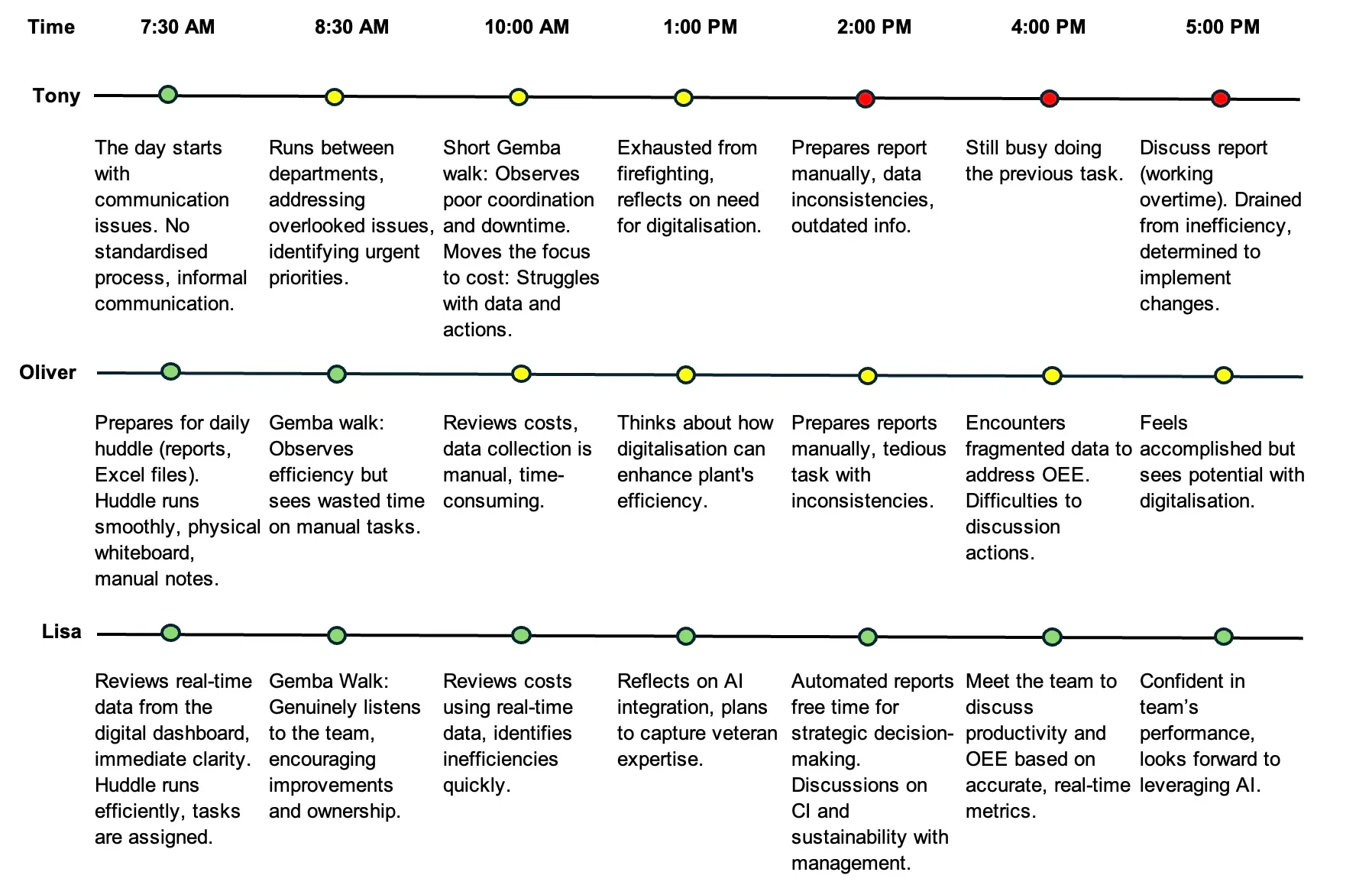
Tony, Oliver, and Lisa all see the promise of digitalisation, but their paths are at different stages. Digitalisation offers solutions tailored to each scenario in operations.
For Tony, the first step will be to improve and standardise workflows, ensuring a solid foundation. Building operational efficiency as they go will be challenging but necessary to avoid amplifying inefficiencies. This effort will demonstrate the benefits of digitalisation, as improvements will come from both digital tools and enhanced work processes.
For Oliver, digitalisation can automate data collection and reporting, making it easier to manage and analyse information without the manual workload. With solid and efficient routines already in place, digitalisation can deliver faster and greater returns. Additionally, real-time data integration will enable proactive decision-making and quicker responses to deviations, helping to avoid losses and improve manufacturing costs.
Lisa has successfully implemented digitalisation, establishing efficient processes that let her focus on continuous improvement. She recognises digitalisation as an evolving journey. With AI now integrated into her tools, she sees new opportunities for innovation. By leveraging AI, she can optimise operations and capture valuable expertise from her workforce. This ensures that her plant remains agile, competitive, and forward-thinking.
No matter the starting point, the journey towards digitalisation is about improving efficiency and driving sustainability in operations. Whether it’s building the foundation with clear routines, automating well-established processes, or seeking new opportunities for improvement, the goal is the same: to empower teams to work smarter, not harder, and to unlock the full potential of their operations.
Embrace Digitalisation: Get Started with Our Resources
Understanding where to begin with digitalisation in operations can be overwhelming, but taking the first step is crucial. Explore our “Digitalisation in Industry: How to Get Started” whitepaper and take the “Digitalisation Maturity Assessment” to understand your current state. These resources help you identify areas for improvement and develop a tailored plan to integrate digital tools into your operations.
Reflecting on your unique challenges and opportunities can help you make informed decisions that lead to meaningful and lasting improvements. Contact us today for a personalised demo and discover how Cyzag can digitalise your operations to the next level.
Follow Cyzag on LinkedIn for new articles and stories.